

Lactobacillus vs Bifidobacterium: What's the Difference and Do You Need Both?
Lactobacillus vs Bifidobacterium: What's the Difference in Your Food, and Do You Need Both?
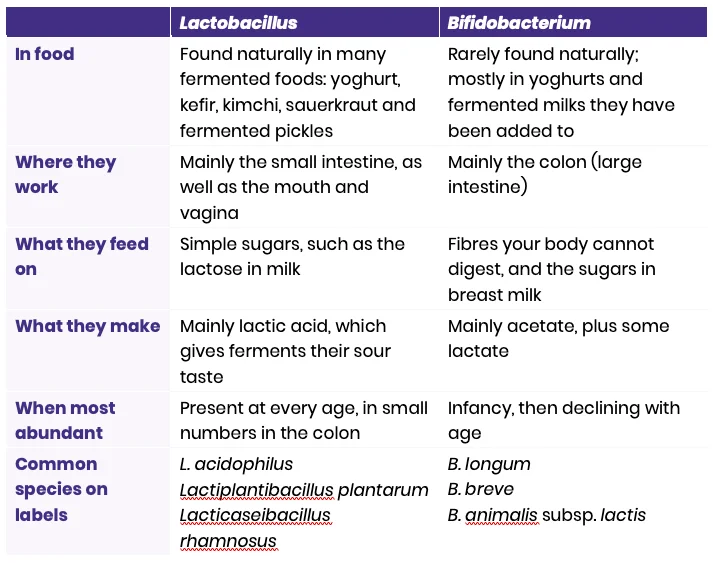
Lactobacillus and Bifidobacterium are the two groups of bacteria you will see most often on probiotic labels, and the main difference in your food is where you find them. Lactobacilli occur naturally in many fermented foods, such as yoghurt, kimchi and sauerkraut, while bifidobacteria rarely do. They mostly reach your plate because they have been added to yoghurts and fermented milks by producers. Inside your body they work in different parts of the gut and do different jobs, and most adults carry both.
In short:
- Lactobacilli are found naturally in many fermented foods. Bifidobacteria rarely are. They are first passed on from your mother, and in food they mostly appear in products they have been added to.
- Lactobacilli work mainly in the small intestine and turn sugars into lactic acid. Bifidobacteria work mainly in the colon and break down fibre.
- Eating fermented foods regularly is linked to a more diverse gut microbiome, though most food bacteria pass through rather than settle.
- The two complement each other because they work in different places, and fibre feeds the bifidobacteria you already carry.
- Probiotic supplements have good evidence for specific strains in a few situations, and limited evidence for most other uses.
What is the difference between Lactobacillus and Bifidobacterium?
Lactobacillus and Bifidobacterium differ in where you find them in food, what they feed on and where they work in your gut. Lactobacilli do not need oxygen to grow, but most can survive in it, so they are easy to keep alive in food. They are also already present on vegetables and tolerate the acid they make, which is why they thrive in ferments like kimchi and sauerkraut. Most bifidobacteria survive poorly when exposed to oxygen, which makes them harder to keep alive in food.
What are the benefits of Lactobacillus and Bifidobacterium in your diet?
Eating foods with live Lactobacillus and Bifidobacterium is linked to a more diverse gut microbiome and easier lactose digestion, and specific strains of each have been studied for digestive and vaginal health.
- A more diverse gut microbiome. In a Stanford trial, 18 healthy adults who gradually increased the fermented food in their diet over 10 weeks, including yoghurt, kefir, kimchi and kombucha, ended up with more diverse gut bacteria and lower levels of inflammatory markers in their blood. Most of the new bacteria did not come from the foods themselves, which suggests fermented foods change the gut environment as well as adding microbes.
- Easier lactose digestion. The live cultures in yoghurt break down some of its lactose, which is why many people who are lactose intolerant can eat yoghurt more comfortably than milk.
- Fibre turned into fuel for your colon. Bifidobacteria break down fibre into acetate and lactate, which other gut bacteria then use to make butyrate, the main fuel for the cells lining your colon.
- Vaginal health. Lactobacilli are the main bacteria in most healthy vaginas, where the lactic acid they make keeps the environment acidic. Specific strains have been studied for vaginal health.
Most of this evidence comes from fermented foods as a whole or from specific strains in supplements. A food's strains and live counts are rarely listed, so it cannot promise the effects found for a particular strain.
What happens to the bacteria you eat?
Some survive the journey, but most do not stay. Food bacteria face stomach acid, bile and competition from the bacteria already living in your gut, and most pass through and are no longer detectable soon after you stop eating them. Four things decide how many make it through:
- The strain. Some strains tolerate acid and bile far better than others, even within the same species.
- How the food was made and stored. Heating after fermentation kills the cultures. Live counts in yoghurt also fall the longer it sits in the fridge, and bifidobacteria, which are more sensitive to oxygen and acid, tend to decline faster than lactobacilli.
- What you eat it with. Food buffers stomach acid, so bacteria eaten with a meal tend to survive better than on an empty stomach.
- Your own gut. The bacteria already in your gut affect whether newcomers can find a foothold, which is why the same strain settles in some people and not in others.
Despite this, bacteria still do useful work while passing through. They break down lactose, make useful acids, and interact with your gut lining on the way. That is why a regular serving matters more than a large one. The same applies to probiotic supplements, where effects linked to most strains fade after you stop taking them. If you are pregnant or have a weakened immune system, check with your doctor before eating unpasteurised ferments.
Is it better to have both in your diet?
Having both makes sense because they work in different parts of your gut and do different jobs, so they complement each other. Lactobacilli work mainly in the small intestine, making lactic acid from simple sugars. Bifidobacteria work mainly in the colon, breaking down fibre and passing acetate and lactate on to the bacteria that make butyrate. Think of them as two specialists working in different rooms of the same house.
Even though there are currently no studies examining whether eating or taking the two together works better than either alone, a varied diet that includes fermented foods and plenty of fibre has been shown to confer health benefits.
How do you feed the Bifidobacterium you already have?
Eat more fibre, especially prebiotic fibres (fibres that gut microbes use selectively, with a health benefit), because bifidobacteria rely on the fibre that reaches your colon undigested. Good everyday sources include:
- Onions, garlic, leeks and spring onions
- Slightly green bananas
- Oats, barley and other whole grains
- Beans, lentils and chickpeas
- Asparagus and chicory root
Bifidobacterium levels tend to fall with age, so fibre becomes more relevant over time. In a study of Japanese people ranging from newborns to 104-year-olds, the share of Bifidobacterium fell after weaning and fell again in older age.
If you would like to know your own starting point, a gut microbiome test can show your Bifidobacterium levels and compare them with a reference database built on Asian gut microbiomes, so your results are set against people whose diets and backgrounds are closer to yours. Lactobacilli are usually too scarce in stool to measure reliably, which is why Bifidobacterium is the more useful marker here.
What does the research say about probiotic supplements?
Research on probiotic supplements is still emerging, and it is becoming more precise as newer trials test named strains, at set doses, for specific outcomes. So far, it supports specific strains for a few specific situations, while the evidence for most other uses is limited or mixed for now. Most trials have been done in people with a particular problem, so evidence for healthy people taking probiotics for general wellbeing is thinner.
The clearest evidence is for antibiotic-associated diarrhoea. A Cochrane review of 23 trials in nearly 3,900 children found that 8% of those given probiotics alongside antibiotics developed diarrhoea, compared with 19% of those who were not. The best results came from Lacticaseibacillus rhamnosus (formerly Lactobacillus rhamnosus) and the probiotic yeast Saccharomyces boulardii.
When deciding if you want to include probiotic supplementation, 3 factors matter the most
- Benefits are strain-specific. A result for one strain does not carry over to another strain, even of the same species.
- Dose matters. In the children's antibiotic trials, the most effective doses were 5 to 40 billion colony-forming units (CFU) a day.
- More strains is not automatically better. A systematic review comparing single strains with mixtures found no consistent advantage for mixtures. What mattered was whether the specific strains had been studied for that outcome.
Why AMILI's formulas use both
Each of AMILI's four probiotic formulas pairs Lactiplantibacillus plantarum and other lactobacilli with one or more of Bifidobacterium breve, B. longum and B. lactis (B. animalis subsp. lactis), so the strains in each formula are designed to complement each other along the gut.
Each formula also contains prebiotic fibres: fructo-oligosaccharides (FOS), guar gum and orange peel extract. These were chosen because, in AMILI's lab research, they promoted the growth of Bifidobacterium. Here is how each formula is put together.
This article is for general information and isn't a substitute for personalised medical advice. If you have ongoing gut symptoms, speak with a doctor.
Frequently Asked Questions
- Can you take Lactobacillus and Bifidobacterium together?
Yes. Many probiotic products combine them, and both have a long history of use in healthy adults. If you have a weakened immune system or a serious illness, speak with your doctor before starting any probiotic. - Is Bifidobacterium a lactic acid bacterium?
Not in the strict sense. Bifidobacteria make some lactic acid, but their main product is acetate, and they sit outside the order Lactobacillales that scientists call lactic acid bacteria. They are often grouped with lactic acid bacteria in food and supplement writing. - Does yoghurt contain Bifidobacterium?
Some yoghurts do. Yoghurt is typically made with Streptococcus thermophilus and Lactobacillus delbrueckii subsp. bulgaricus, and bifidobacteria are added to some products as extra cultures. Check the label for Bifidobacterium, or B. followed by a species name. - Does sourdough bread contain live Lactobacillus?
No. Sourdough starter is rich in lactobacilli, but baking kills them. The bread can still carry some of the acids and other compounds they made during fermentation. - Where do the bifidobacteria in your gut come from?
Mostly from your mother. Babies pick up bifidobacteria during a vaginal birth and through breastfeeding, and the complex sugars in breast milk (human milk oligosaccharides) help them multiply quickly, which is why babies carry more than adults. Few everyday foods contain bifidobacteria, so after infancy fibre matters most, because it feeds the ones you already carry. - Can a gut microbiome test measure Lactobacillus?
Not reliably in most people, because lactobacilli make up a very small share of the bacteria in stool. Bifidobacterium is present in larger numbers, so it is easier to measure and compare. - Is Lactiplantibacillus plantarum the same as Lactobacillus plantarum?
Yes. It is the same species under its new name, following the 2020 reclassification of the genus Lactobacillus. In 2020, scientists split the genus Lactobacillus into 25 genera based on genetic differences, so many familiar species were renamed. Older labels and studies still use Lactobacillus plantarum. - Should you take a probiotic while on antibiotics?
Specific strains have been studied for this, with the strongest evidence for reducing antibiotic-associated diarrhoea in children. The benefit depends on the strain and dose, so speak with your doctor or pharmacist about which one suits your situation.
Glossary
- Acetate: A short-chain fatty acid and the main product bifidobacteria make from fibre. Other gut bacteria use it to make butyrate.
- Butyrate: A short-chain fatty acid made by certain colon bacteria. It is the main fuel for the cells lining the colon.
- Colony-forming units (CFU): A measure of how many live microbes a product contains. Probiotic doses are usually given in billions of CFU.
- Fermented food: A food made through desired microbial growth and the conversion of food components by microbial enzymes.
- Human milk oligosaccharides (HMOs): Complex sugars in breast milk that babies cannot digest but bifidobacteria can.
- Lactic acid bacteria: In the strict sense, bacteria in the order
- Lactobacillales, which mainly produce lactic acid. Bifidobacteria are often grouped with them but are not part of this order.
- Prebiotic: A food component, usually a fibre, that is selectively used by microbes in the body and provides a health benefit.
- Probiotic: Live microorganisms that provide a health benefit when taken in adequate amounts.
- Starter culture: Microbes added by producers to begin fermentation, such as the bacteria used to make yoghurt.
- Strain: A genetically distinct type within a species, usually shown as a code after the species name. Findings for one strain do not automatically apply to another.
About the Author
Yuzu Tay is a science communicator trained in biomedical engineering and leads marketing and communications at AMILI. Her focus is on translating and sharing real science to help people make better decisions about their health, staying close to what the evidence does and does not show. Her work spans cancer companion diagnostics, liver fibrosis and gut health.
References
- EFSA Panel on Dietetic Products, Nutrition and Allergies. "Scientific Opinion on the Substantiation of Health Claims Related to Live Yoghurt Cultures and Improved Lactose Digestion (ID 1143, 2976) Pursuant to Article 13(1) of Regulation (EC) No 1924/2006." EFSA Journal, vol. 8, no. 10, 2010, article 1763, https://doi.org/10.2903/j.efsa.2010.1763.
- Gibson, Glenn R., et al. "Expert Consensus Document: The International Scientific Association for Probiotics and Prebiotics (ISAPP) Consensus Statement on the Definition and Scope of Prebiotics." Nature Reviews Gastroenterology & Hepatology, vol. 14, no. 8, 2017, pp. 491-502, https://doi.org/10.1038/nrgastro.2017.75.
- Goldenberg, Joshua Z., et al. "Probiotics for the Prevention of Pediatric Antibiotic-Associated Diarrhea." Cochrane Database of Systematic Reviews, no. 12, 2015, CD004827, https://doi.org/10.1002/14651858.CD004827.pub4.
- Guo, Qin, et al. "Probiotics for the Prevention of Pediatric Antibiotic-Associated Diarrhea." Cochrane Database of Systematic Reviews, no. 4, 2019, CD004827, https://doi.org/10.1002/14651858.CD004827.pub5.
- Hill, Colin, et al. "Expert Consensus Document: The International Scientific Association for Probiotics and Prebiotics Consensus Statement on the Scope and Appropriate Use of the Term Probiotic." Nature Reviews Gastroenterology & Hepatology, vol. 11, no. 8, 2014, pp. 506-14, https://doi.org/10.1038/nrgastro.2014.66.
- McFarland, Lynne V. "Efficacy of Single-Strain Probiotics Versus Multi-Strain Mixtures: Systematic Review of Strain and Disease Specificity." Digestive Diseases and Sciences, vol. 66, no. 3, 2021, pp. 694-704, https://doi.org/10.1007/s10620-020-06244-z.
- Makino, Hiroshi, et al. "Mother-to-Infant Transmission of Intestinal Bifidobacterial Strains Has an Impact on the Early Development of Vaginally Delivered Infant's Microbiota." PLOS ONE, vol. 8, no. 11, 2013, e78331, https://doi.org/10.1371/journal.pone.0078331.
- Odamaki, Toshitaka, et al. "Age-Related Changes in Gut Microbiota Composition from Newborn to Centenarian: A Cross-Sectional Study." BMC Microbiology, vol. 16, 2016, article 90, https://doi.org/10.1186/s12866-016-0708-5.
- Rivière, Audrey, et al. "Bifidobacteria and Butyrate-Producing Colon Bacteria: Importance and Strategies for Their Stimulation in the Human Gut." Frontiers in Microbiology, vol. 7, 2016, article 979, https://doi.org/10.3389/fmicb.2016.00979.
- Roselli, Marianna, et al. "Colonization Ability and Impact on Human Gut Microbiota of Foodborne Microbes from Traditional or Probiotic-Added Fermented Foods: A Systematic Review." Frontiers in Nutrition, vol. 8, 2021, article 689084, https://doi.org/10.3389/fnut.2021.689084.
- Su, Grace L., et al. "AGA Clinical Practice Guidelines on the Role of Probiotics in the Management of Gastrointestinal Disorders." Gastroenterology, vol. 159, no. 2, 2020, pp. 697-705, https://doi.org/10.1053/j.gastro.2020.05.059.
- Walter, Jens. "Ecological Role of Lactobacilli in the Gastrointestinal Tract: Implications for Fundamental and Biomedical Research." Applied and Environmental Microbiology, vol. 74, no. 16, 2008, pp. 4985-96, https://doi.org/10.1128/AEM.00753-08.
- Wastyk, Hannah C., et al. "Gut-Microbiota-Targeted Diets Modulate Human Immune Status." Cell, vol. 184, no. 16, 2021, pp. 4137-53, https://doi.org/10.1016/j.cell.2021.06.019.
- Zheng, Jinshui, et al. "A Taxonomic Note on the Genus Lactobacillus: Description of 23 Novel Genera, Emended Description of the Genus Lactobacillus Beijerinck 1901, and Union of Lactobacillaceae and Leuconostocaceae." International Journal of Systematic and Evolutionary Microbiology, vol. 70, no. 4, 2020, pp. 2782-858, https://doi.org/10.1099/ijsem.0.004107.
- Zmora, Niv, et al. "Personalized Gut Mucosal Colonization Resistance to Empiric Probiotics Is Associated with Unique Host and Microbiome Features." Cell, vol. 174, no. 6, 2018, pp. 1388-405, https://doi.org/10.1016/j.cell.2018.08.041.
Articlesyoumightbeinterestedin

Natural Food Sources of Lactobacillus, and Which Still Contain Live Bacteria
Whether you get live bacteria from them depends on how the food was made and handled after fermentation, because heat, pasteurisation and vinegar pickling remove them.

Bacterial Spotlight: All About Bifidobacteria
Learn what Bifidobacteria do in your gut, how levels change from infancy to old age, and how prebiotic fibres and resistant starch help them grow.

How to Choose a Probiotic That Works for You: A Methodical Approach
A 5-step process to understanding probiotics and choosing one that would work for you.