Which probiotics can help women manage weight?
The best probiotics for weight loss for women, backed by human trials. See which strains help during PMOS and menopause, and what heat-killed Akkermansia adds.
By Amili team
Updated 27 Oct 2026 · 6 min read


No probiotic will melt fat. But a few, tested in women, can nudge the numbers in the right direction.
The catch is that results belong to specific strains, not to probiotics in general. Two have the most direct evidence in women so far. One is Lacticaseibacillus rhamnosus CGMCC1.3724, taken alongside a calorie reduced diet. The other is pasteurised Akkermansia muciniphila, taken alongside standard treatment in women with PMOS. In both cases, the changes were modest, appeared over about 12 weeks, and added to diet and activity rather than replacing them. Here's what the trials found, strain by strain and life stage by life stage.
Do women respond differently to probiotics for weight loss?
Possibly, and one trial makes a striking case. In Canada, 125 adults with obesity followed a calorie reduced diet for 12 weeks while taking either L. rhamnosus CGMCC1.3724 or a placebo, then were followed for another 12 weeks (Sanchez et al.). The capsules also contained a small dose of prebiotic fibre.
Women on the probiotic lost 4.4 kg on average in the first 12 weeks, compared with 2.6 kg on placebo. Men saw no difference at all (Sanchez et al.). And when the diet stopped, the women on the probiotic kept losing weight and fat mass for the next 12 weeks (Sanchez et al.).
The trial wasn't designed to explain why. The authors noted that men on placebo responded more strongly to the diet itself, which may have masked any effect of the probiotic (Sanchez et al.).
Life stage matters too, because it changes what you're trying to shift. Women with PMOS (formerly PCOS) commonly have insulin resistance, which affects how the body handles glucose and stores fat (Talebi et al.).
What is heat-killed, or pasteurised, Akkermansia?
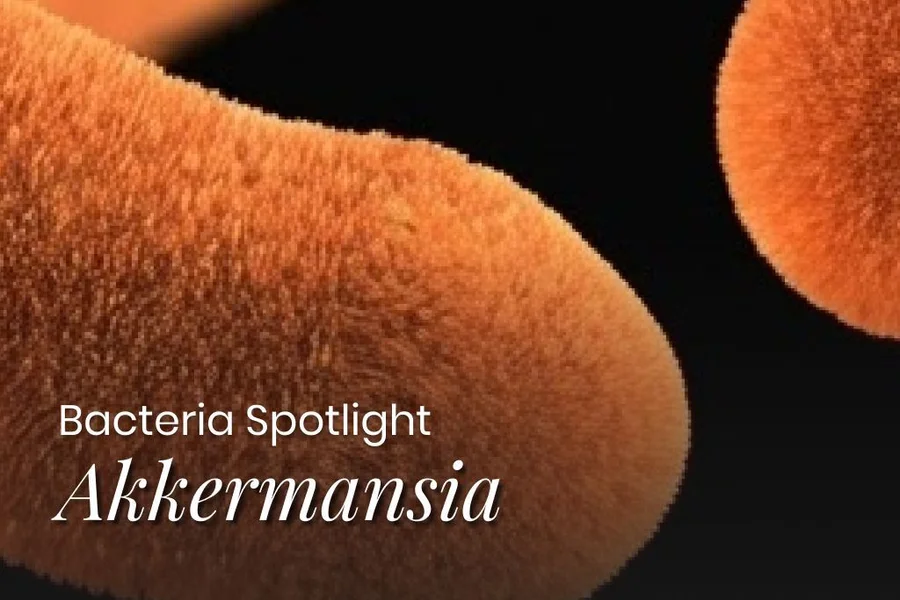
Akkermansia muciniphila is a bacterium that lives in the mucus layer lining your gut. People with overweight, obesity, or untreated type 2 diabetes tend to have less of it (Depommier et al.).
In the heat-killed form, mild heat (pasteurisation) inactivates the bacteria before you take them. This means they can no longer colonise your gut, and the formulation stays stable on the shelf for longer.
That makes heat-killed Akkermansia a postbiotic: a preparation of inactivated microorganisms, or their components, that still gives a health benefit to the person taking it (Salminen et al.).
What did the first human trial of pasteurised Akkermansia find?
The first human trial was a three month randomised, double blind, placebo controlled pilot in Belgium. It enrolled 40 adults with overweight or obesity and insulin resistance, and 32 completed it (Depommier et al.). Compared with placebo, pasteurised A. muciniphila improved insulin sensitivity by about 29%, lowered blood insulin by about 34% and cut total cholesterol by about 9%. Blood markers of liver dysfunction and inflammation also fell, while the overall makeup of the gut microbiome stayed the same (Depommier et al.). Body weight and fat mass changed only slightly.
The live form of the same bacterium produced fewer of these changes (Depommier et al.), which is why later research has focused on the heat killed form.
Can heat-killed Akkermansia help women with PMOS manage weight?
To preface: in May 2026, an international consensus published in The Lancet renamed polycystic ovary syndrome (PCOS) as polyendocrine metabolic ovarian syndrome (PMOS) (Teede et al.). The new name reflects the condition's hormonal and metabolic features, including insulin resistance.
A 12-week randomised controlled trial in China enrolled 100 women with obesity associated PMOS who were already taking a standard oral contraceptive (Zeng et al.). Half added pasteurised A. muciniphila at 10 billion cell equivalents a day, and half added a placebo.
Women in the Akkermansia group lost 1.9 kg on average, compared with 0.4 kg on placebo (Zeng et al.). They also had lower testosterone and better insulin and blood fat markers. Signs of excess androgens, such as acne and unwanted hair growth, improved more too (Zeng et al.).
One caveat: the postbiotic was taken on top of medical treatment, so these results don't show what it does on its own.
Earlier trials in this group used live probiotics. An umbrella review of meta-analyses in women with PCOS found that probiotics modestly lowered insulin resistance (HOMA IR), with moderate certainty (Talebi et al.). An overview of eight systematic reviews reported possible benefits for BMI, but the trials varied too much to name the best strains or doses (Angoorani et al.).
How do you choose the right probiotic for your weight goal?
Match the trial to your life stage. If you have PMOS, the Akkermansia postbiotic trial is the closest match (Zeng et al.).
Check the strain code and the dose. Results belong to a strain, not a whole species. A label that only says "Lactobacillus rhamnosus" doesn't tell you whether you're getting CGMCC1.3724 or a strain with no weight data at all.
Give it 12 weeks, and measure your waist. Most of these trials ran for 12 weeks, and several tracked body fat and visceral fat, which the scale alone won't show. In every case, the probiotic worked alongside diet and lifestyle changes, not instead of them.
Where does AMILI's Metabolic Health Daily Synbiotics fit?
The pasteurised Akkermansia is the same form tested for insulin sensitivity and, more recently, in women with PMOS (Depommier et al.; Zeng et al.). Pairing an L. rhamnosus probiotic with prebiotic fibre also mirrors the approach used in the women's weight loss trial (Sanchez et al.). The product doesn't list strain codes or the Akkermansia dose, though, so we can't assume it will produce the same results as these trials.
Who should check with a doctor first?
Speak to your doctor before taking a probiotic for weight if you're pregnant, trying to conceive or breastfeeding, or if you take medicine for PMOS, diabetes or cholesterol.
A 2023 review advised weighing Akkermansia supplements case by case in women with PCOS or endometriosis, because these groups have a higher risk of inflammatory bowel disease (Chiantera et al.). If you have inflammatory bowel disease or a weakened immune system, ask your doctor first.
The right probiotic won't do the work for you. But the right strain, at the right dose, taken for long enough, can make that work go a little further.
Glossary
- Postbiotic: a preparation of inactivated microorganisms, or their components, that gives a health benefit (Salminen et al.)
- Pasteurised (heat-killed): inactivated with mild heat so the bacteria are no longer alive
- Akkermansia muciniphila: a gut bacterium that lives in the mucus layer of the intestine
- Strain code: the letters and numbers after a species name, such as CGMCC1.3724, that identify the exact strain tested
- CFU: colony-forming units, a count of live bacteria in a dose
- Insulin resistance: when cells respond less to insulin, so the body needs more of it to manage blood glucose
- Visceral fat: fat stored deep in the abdomen around the organs
- PMOS: polyendocrine metabolic ovarian syndrome, the new name for polycystic ovary syndrome (PCOS)
References
- 1.AMILI. "Metabolic Health." AMILI, amili.asia/products/metabolic-health-formulation. Accessed 21 Oct. 2026.
- 2.Angoorani, Pooneh, et al. "The Effects of Probiotics, Prebiotics, and Synbiotics on Polycystic Ovarian Syndrome: An Overview of Systematic Reviews." Frontiers in Medicine, vol. 10, 2023, article 1141355, https://doi.org/10.3389/fmed.2023.1141355.
- 3.Chiantera, Vito, et al. "A Critical Perspective on the Supplementation of Akkermansia muciniphila: Benefits and Harms." Life, vol. 13, no. 6, 2023, article 1247, https://doi.org/10.3390/life13061247.
- 4.Depommier, Clara, et al. "Supplementation with Akkermansia muciniphila in Overweight and Obese Human Volunteers: A Proof-of-Concept Exploratory Study." Nature Medicine, vol. 25, no. 7, 2019, pp. 1096–103, https://doi.org/10.1038/s41591-019-0495-2.
- 5.Salminen, Seppo, et al. "The International Scientific Association of Probiotics and Prebiotics (ISAPP) Consensus Statement on the Definition and Scope of Postbiotics." Nature Reviews Gastroenterology & Hepatology, vol. 18, 2021, pp. 649–67, https://doi.org/10.1038/s41575-021-00440-6.
- 6.Sanchez, Marina, et al. "Effect of Lactobacillus rhamnosus CGMCC1.3724 Supplementation on Weight Loss and Maintenance in Obese Men and Women." British Journal of Nutrition, vol. 111, no. 8, 2014, pp. 1507–19, https://doi.org/10.1017/S0007114513003875.
- 7.Talebi, Sepide, et al. "The Effects of Pro-, Pre-, and Synbiotics Supplementation on Polycystic Ovary Syndrome: An Umbrella Review of Meta-Analyses of Randomized Controlled Trials." Frontiers in Nutrition, vol. 10, 2023, article 1178842, https://doi.org/10.3389/fnut.2023.1178842.
- 8.Teede, Helena, et al. [Polyendocrine metabolic ovarian syndrome, the new name for polycystic ovary syndrome: a multistep global consensus process] The Lancet, May 2026.
- 9.Zeng, Qingwei, et al. "Adjunctive Akkermansia muciniphila Postbiotic Supplementation Modulates Metabolic and Endocrine Profiles in Obesity-Associated Polyendocrine Metabolic Ovarian Syndrome: A Randomized Controlled Trial." Clinical Nutrition, 2026, article 106782, https://doi.org/10.1016/j.clnu.2026.106782.
This article is for general information and does not replace advice from your doctor. Speak to a healthcare professional before making changes to your treatment.
Written
Written by
Amili team