Cooking and processing of seaweed impact on protein digestibility and gut microbiome
International Conference on Food Digestion (2024).
By Amili team
Updated 15 Nov 2026 · 4 min read


Geraldine Oh¹, Eleanor Cheong², Cherry Thaw¹, Stephen Haines³, Alastair Ross³, Dale Bowie⁴, Shaun How⁵, Jonathan Teo⁵, Niranjan Nagarajan⁵, Elizabeth Rettedal⁶, Kai Yee Toh⁷, Jeremy Lim⁷, Clare Bradley⁸, Tane Bradley⁸, David Everett⁹,¹⁰, Santanu Deb-Choudhury³, Linda Samuelsson¹⁰, James Chan¹
BACKGROUND
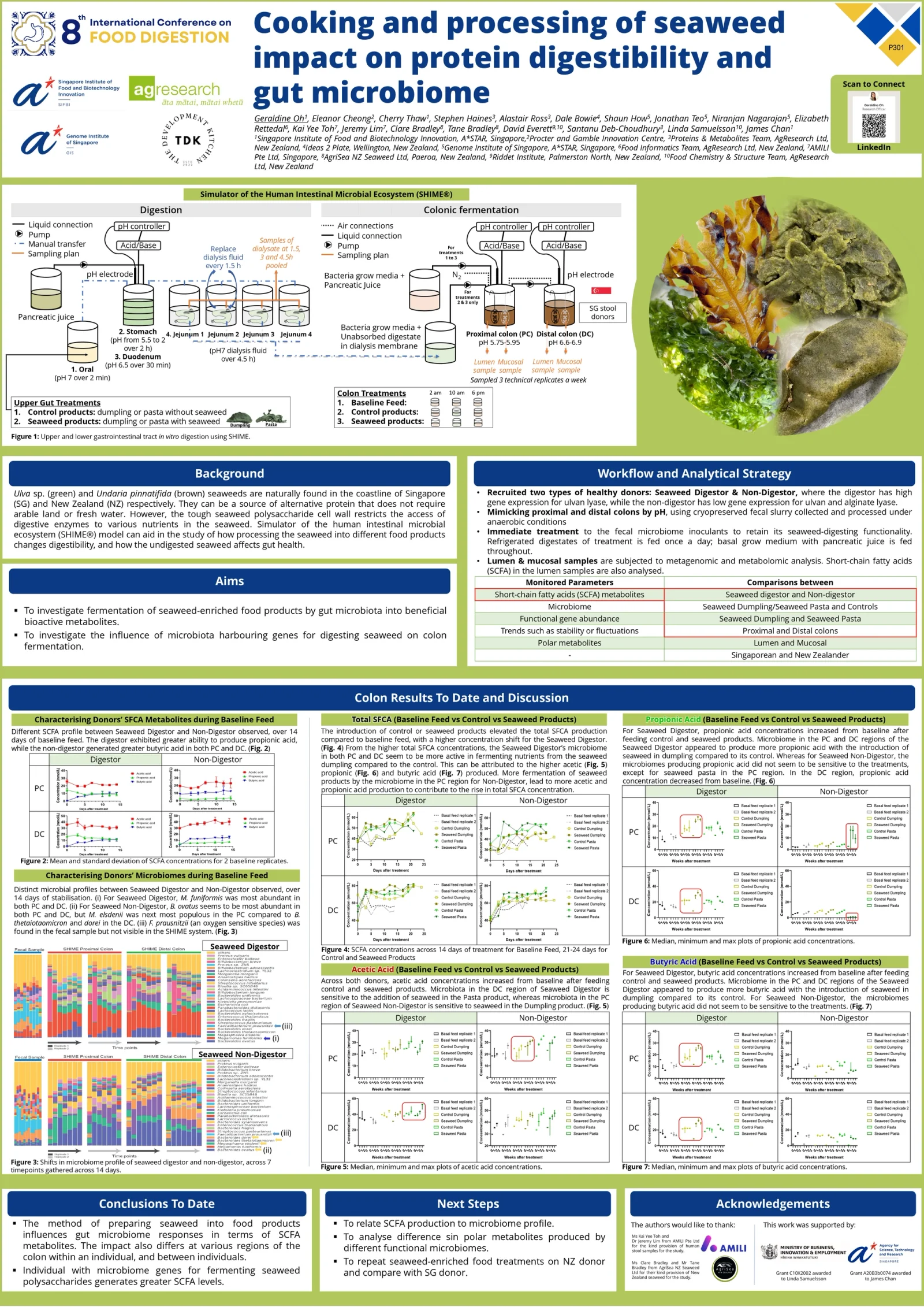
Ulva sp. (green) and Undaria pinnatifida (brown) seaweeds are naturally found in the coastline of Singapore (SG) and New Zealand (NZ) respectively. They can be a source of alternative protein that does not require arable land or fresh water. However, the tough seaweed polysaccharide cell wall restricts the access of digestive enzymes to various nutrients in the seaweed. The Simulator of the Human Intestinal Microbial Ecosystem (SHIME®) model can aid in the study of how processing the seaweed into different food products changes digestibility, and how the undigested seaweed affects gut health.
AIMS
- To investigate fermentation of seaweed-enriched food products by gut microbiota into beneficial bioactive metabolites.
- To investigate the influence of microbiota harbouring genes for digesting seaweed on colon fermentation.
WORKFLOW AND ANALYTICAL STRATEGY
- Recruited two types of healthy donors: Seaweed Digestor & Non-Digestor, where the digestor has high gene expression for ulvan lyase, while the non-digestor has low gene expression for ulvan and alginate lyase.
- Mimicking proximal and distal colons by pH, using cryopreserved fecal slurry collected and processed under anaerobic conditions.
- Immediate treatment to the fecal microbiome inoculants to retain its seaweed-digesting functionality. Refrigerated digestates of treatment are fed once a day; basal grow medium with pancreatic juice is fed throughout.
- Lumen & mucosal samples are subjected to metagenomic and metabolomic analysis. Short-chain fatty acids (SCFA) in the lumen samples are also analysed.
COLON RESULTS TO DATE & DISCUSSIONS
Characterising Donors’ SCFA Metabolites during Baseline Feed
Different SCFA profiles between the Seaweed Digestor and Non-Digestor were observed over 14 days of baseline feed. The digestor exhibited greater ability to produce propionic acid, while the non-digestor generated greater butyric acid in both PC and DC. (Fig. 2)
Characterising Donors’ Microbiomes during Baseline Feed
Distinct microbial profiles between Seaweed Digestor and Non-Digestor observed, over 14 days of stabilisation. (i) For Seaweed Digestor, M. funiformis was most abundant in both PC and DC. (ii) For Seaweed Non-Digestor, B. ovatus seems to be most abundant in both PC and DC, but M. elsdenii was next most populous in the PC compared to B. thetaiotaomicron and dorei in the DC. (iii) F. prausnitzii (an oxygen sensitive species) was found in the fecal sample but not visible in the SHIME system. (Fig. 3)
Total SCFA (Baseline Feed vs Control vs Seaweed Products)
The introduction of control or seaweed products elevated the total SCFA production compared to baseline feed, with a higher concentration shift for the Seaweed Digestor. (Fig. 4) From the higher total SCFA concentrations, the Seaweed Digestor’s microbiome in both PC and DC seem to be more active in fermenting nutrients from the seaweed dumpling compared to the control. This can be attributed to the higher acetic (Fig. 5), propionic (Fig. 6) and butyric acid (Fig. 7) produced. More fermentation of seaweed products by the microbiome in the PC region for Non-Digestor led to more acetic and propionic acid production, contributing to the rise in total SCFA concentration.
Acetic Acid (Baseline Feed vs Control vs Seaweed Products)
Across both donors, acetic acid concentrations increased from baseline after feeding control and seaweed products. Microbiota in the DC region of Seaweed Digestor is sensitive to the addition of seaweed in the Pasta product, whereas microbiota in the PC region of Seaweed Non-Digestor is sensitive to seaweed in the Dumpling product. (Fig. 5)
Propionic Acid (Baseline Feed vs Control vs Seaweed Products)
For Seaweed Digestor, propionic acid concentrations increased from baseline after feeding control and seaweed products. Microbiome in the PC and DC regions of the Seaweed Digestor appeared to produce more propionic acid with the introduction of seaweed in dumpling compared to its control. Whereas for Seaweed Non-Digestor, the microbiomes producing propionic acid did not seem to be sensitive to the treatments, except for seaweed pasta in the PC region. In the DC region, propionic acid concentration decreased from baseline. (Fig. 6)
Butyric Acid (Baseline Feed vs Control vs Seaweed Products)
For Seaweed Digestor, butyric acid concentrations increased from baseline after feeding control and seaweed products. Microbiome in the PC and DC regions of the Seaweed Digestor appeared to produce more butyric acid with the introduction of seaweed in dumpling compared to its control. For Seaweed Non-Digestor, the microbiomes producing butyric acid did not seem to be sensitive to the treatments. (Fig. 7)
Conclusions To Date
- The method of preparing seaweed into food products influences gut microbiome responses in terms of SCFA metabolites. The impact also differs at various regions of the colon within an individual, and between individuals.
- An individual with microbiome genes for fermenting seaweed polysaccharides generates greater SCFA levels.
Next Steps
- To relate SCFA production to microbiome profile.
- To analyse differences in polar metabolites produced
- To repeat seaweed-enriched food treatments on an NZ donor and compare with the SG donor.
This article is for general information and does not replace advice from your doctor. Speak to a healthcare professional before making changes to your treatment.
Written
Written by
Amili team