Prevalence of Kp carriage in Singapore healthy population assessed by metagenome-assembled genomes
Chang, Y.-J., Toh, K. Y., Lim, J. F. Y., Ong, R. T.-H., Teo, J. Q.-M., & Chong, C. W. (2024).
By Amili team
Updated 15 Nov 2026 · 3 min read


Chang, Y.-J., Toh, K. Y., Lim, J. F. Y., Ong, R. T.-H., Teo, J. Q.-M., & Chong, C. W. (2024). Prevalence of Klebsiella pneumoniae (Kp) carriage in Singapore healthy population assessed by metagenome-assembled genomes
BACKGROUND
Klebsiella pneumoniae (Kp), a bacterium commonly found in the environment and colonise the gut and respiratory tract of healthy individuals without causing illness.
Carriage rates vary significantly based on factors like age, location, healthcare exposure, and underlying health conditions. Studies in Asian populations
reported wide Kp carriage rates between 19% and 88%, with local Kp bacteriemia mortality rates of 20-26%. However, carriage rate of Kp amongst
Singapore healthy population remains unknown. This study thus aimed to determine Kp carriage rate in a healthy Singapore adult population and assess
presence of hypervirulent and resistance genes.
METHODOLOGY
Stool samples from 552 healthy adult individuals with no self-reported medical conditions and antibiotics use in the past three months were analysed using shotgun metagenomics sequencing on Illumina NovaSeq platform at 20 million paired-end reads. AMILI’s proprietary in-house de novo assembly pipeline identified high-quality Kp metagenome-assembled genomes (MAGS)
against Kp genomes from Unified Human Gastrointestinal Genome (UHGG) collection, supplemented with SGH10 strain. Translated proteins from these MAGs were further compared against AMRFinder and Kleborate to identify hypervirulent and resistant genes, and multi-locus sequence types.
RESULTS
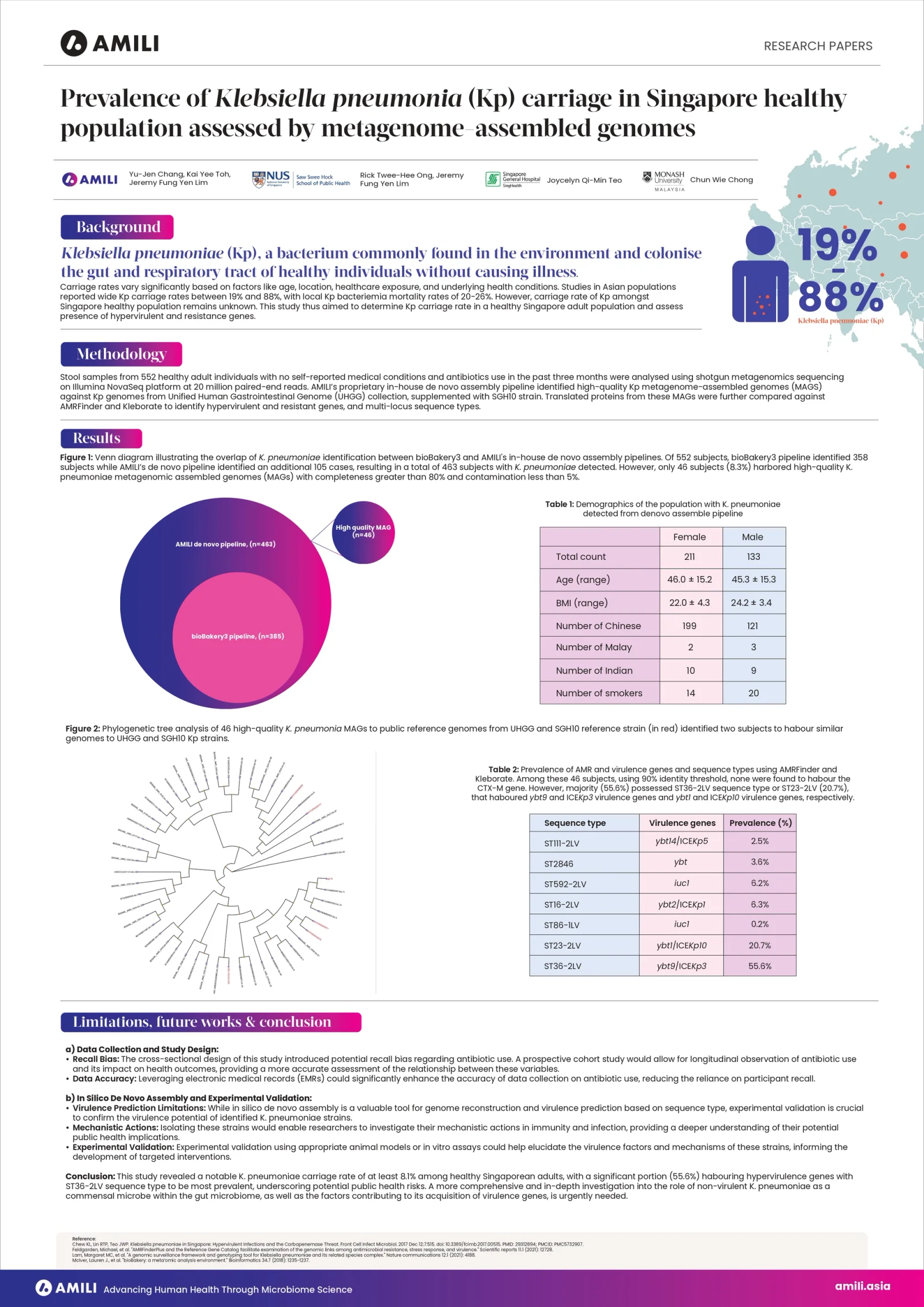
Figure 1: Of 552 subjects, bioBakery3 pipeline identified 358 subjects while AMILI’s de novo pipeline identified an additional 105 cases, resulting in a total of 463 subjects with K. pneumoniae detected. However, only 46 subjects (8.3%) harbored high-quality K. pneumoniae metagenomic assembled genomes (MAGs) with completeness greater than 80% and contamination less than 5%.
Figure 2: Phylogenetic tree analysis of 46 high-quality K. pneumonia MAGs to public reference genomes from UHGG and SGH10 reference strain (in red) identified two subjects to habour similar genomes to UHGG and SGH10 Kp strains.
LIMITATIONS, FUTURE WORKS AND CONCLUSIONS
a) Data Collection and Study Design:
• Recall Bias: The cross-sectional design of this study introduced potential recall bias regarding antibiotic use. A prospective cohort study would allow for longitudinal observation of antibiotic use and its impact on health outcomes, providing a more accurate assessment of the relationship between these variables.
• Data Accuracy: Leveraging electronic medical records (EMRs) could significantly enhance the accuracy of data collection on antibiotic use, reducing the reliance on participant recall.
b) In Silico De Novo Assembly and Experimental Validation:
• Virulence Prediction Limitations: While in silico de novo assembly is a valuable tool for genome reconstruction and virulence prediction based on sequence type, experimental validation is crucial
to confirm the virulence potential of identified K. pneumoniae strains.
• Mechanistic Actions: Isolating these strains would enable researchers to investigate their mechanistic actions in immunity and infection, providing a deeper understanding of their potential public health implications.
• Experimental Validation: Experimental validation using appropriate animal models or in vitro assays could help elucidate the virulence factors and mechanisms of these strains, informing the development of targeted interventions.
Conclusion:
This study revealed a notable K. pneumoniae carriage rate of at least 8.1% among healthy Singaporean adults, with a significant portion (55.6%) habouring hypervirulence genes with ST36-2LV sequence type to be most prevalent, underscoring potential public health risks. A more comprehensive and in-depth investigation into the role of non-virulent K. pneumoniae as a commensal microbe within the gut microbiome, as well as the factors contributing to its acquisition of virulence genes, is urgently needed.
References
- 1.Chew KL, Lin RTP, Teo JWP. Klebsiella pneumoniae in Singapore: Hypervirulent Infections and the Carbapenemase Threat. Front Cell Infect Microbiol. 2017 Dec 12;7:515. doi: 10.3389/fcimb.2017.00515. PMID: 29312894; PMCID: PMC5732907.
- 2.Feldgarden, Michael, et al. "AMRFinderPlus and the Reference Gene Catalog facilitate examination of the genomic links among antimicrobial resistance, stress response, and virulence." Scientific reports 11.1 (2021): 12728.
- 3.Lam, Margaret MC, et al. "A genomic surveillance framework and genotyping tool for Klebsiella pneumoniae and its related species complex." Nature communications 12.1 (2021): 4188. McIver, Lauren J., et al. "bioBakery: a meta’omic analysis environment." Bioinformatics 34.7 (2018): 1235-1237
This article is for general information and does not replace advice from your doctor. Speak to a healthcare professional before making changes to your treatment.
Written
Written by
Amili team