Where to Buy Probiotics in Singapore
Where you buy a probiotic in Singapore shapes what you get, from who checked it to whether it is genuine.
By Yuzu Tay
Updated 1 Nov 2026 · 8 min read



Key takeaways
- You can buy probiotics in Singapore at pharmacy chains such as Unity, Guardian, Watsons, on brand websites, on marketplaces such as Shopee and Lazada, and through some clinics.
- HSA does not approve probiotics or other health supplements before they go on sale, so the checks made by the companies that make, import and sell them are part of the quality of what you buy.
- Pharmacies give you checked stock and a pharmacist to ask, brand websites give you the full range and storage handled by the maker, and clinics give you a doctor's assessment before a product is recommended.
- Marketplaces carry the most risk of fake or poorly stored probiotics, and buying from the brand's official store there lowers that risk.
- Wherever you buy, five details on the label tell you most of what you need to know. These are the strain, the number of live bacteria guaranteed until expiry, the expiry date, the storage instructions and a local distributor.
If you are deciding where to buy probiotics in Singapore, your options are a pharmacy chain, the brand's own website, an online marketplace or a clinic. Each differs in who has checked the product before it reaches you, how it was stored on the way, and how sure you can be that it is genuine. They also carry different ranges, since some probiotics are sold through only one channel.
Who checks a probiotic before it reaches you in Singapore?
Before a probiotic reaches you in Singapore, the checks are made mainly by the companies that make, import and sell it, because the Health Sciences Authority (HSA) does not approve health supplements before they go on sale. Probiotic capsules and powders are sold as health supplements, which HSA treats as lower-risk products made from ingredients with a long history of safe use.
HSA places the responsibility on dealers, a group that covers manufacturers, importers, distributors and retailers. Dealers must make sure their products are safe and of good quality, contain no medicinal ingredients such as steroids, stay within HSA's limits for heavy metals, and make no claims to treat or prevent disease. HSA then monitors products already on sale, by sampling them and tracking reports of side effects, and can recall those that fall short.
This may change. In July 2026, HSA consulted on a proposal that would require health supplements to be notified to HSA before they can be sold, with new requirements phased in from 2028 and full implementation expected in 2030.
Until then, each seller's own checks are part of the quality of the probiotic you buy, which is why where you buy it matters. One check you can make yourself is HSA's public list of voluntarily notified products, where companies declare that a product meets HSA's guidelines. Being listed is not an HSA endorsement, and many sound products are not on the list, since notification is optional.
Pharmacy, brand, marketplace or clinic: how do they compare?
Pharmacies, brand websites, online marketplaces and clinics each check probiotics differently before selling them, and they differ in range, storage and the help you can get. Each option is described below in the same order, and the sections that follow explain each one in more detail.
- Pharmacy chains. The chain decides which products to stock and buys them from the brand or its local distributor. The range is mainstream and narrower. Stock is kept in-store, and you can go back to the shop or the brand with a problem. Many outlets have a pharmacist you can ask.
- Brand websites. The maker sells to you directly, with no seller in between. You get the brand's full range, storage is in the brand's hands until delivery, and you deal with the maker if something is wrong. Advice comes from the brand's own customer team.
- Online marketplaces. The platform hosts many sellers, from official brand stores to individual resellers, and checks vary by seller. The range is the widest, including products made for other countries. Storage and transit depend on the seller and courier, and you go back to the seller through the platform. There is usually no one qualified to advise you.
- Clinics and practitioners. A doctor or practitioner chooses which products to carry and recommends one after assessing you. The range is small and may include clinic-only products that some brands do not sell anywhere else. Storage is handled by the clinic, and your doctor is the person you go back to.
What do pharmacies like Unity, Guardian, and Watsons check before stocking a probiotic?
Probiotics at Unity, Guardian, and Watsons reach the shelf through the chain's own buying process, which means a second company has looked at the product before you do. Because HSA does not approve supplements before sale, a chain that sells a health supplement shares responsibility for it as a dealer, so chains generally ask suppliers for product and labelling information before agreeing to stock it. The details differ between chains and are not published.
Buying from a pharmacy also means the stock comes from the brand or its appointed local distributor, rather than from an unknown source, and is kept in an indoor store rather than sitting in a delivery van. Products that need refrigeration should be in a chiller, and it is worth checking that they are before you buy. Many outlets also have a pharmacist you can ask, which is useful if you take other medicines or are buying for a child.
The trade-off is choice. Shelf space is limited, so pharmacies tend to carry well-known, mainstream products and a few formats from each brand. If you are looking for a specific strain or a newer brand, you may need to buy it from the brand directly.
Are probiotics on Shopee and Lazada genuine?
Probiotics on Shopee and Lazada can be genuine, especially from a brand's official store, but marketplaces carry the highest risk of fake or poorly stored products, because sellers list products themselves and range from the brand to individual resellers. In 2025, HSA removed 2,358 listings of illegal health products from local e-commerce and social media platforms, and Shopee, Lazada and TikTok had the most such listings. These were listings by individual sellers, and the figures cover health products in general, many of them prescription medicines, rather than probiotics alone.
Three other things can affect what arrives at your door, even when the product is genuine.
- Parallel imports. Some sellers bring in stock made for another country, without the brand's local distributor. The formula, label language or storage advice can differ, and there may be no local company responsible for the product.
- Storage before it is sent. A reseller may keep stock at home or in a warehouse without temperature control, and you cannot see how long it has been there.
- Heat in transit. Parcels in Singapore can sit in hot vans and lobbies. This matters most for probiotics that need refrigeration, since the live bacteria in them lose numbers faster when they are warm.
The simplest step is to buy from the brand's official store, marked as Shopee Mall or LazMall, or from a pharmacy chain's own store on the platform. Before you order from any other seller, check how long the store has been open, read reviews that mention expiry dates and packaging, and be wary of prices far below the brand's own. When the parcel arrives, check the seal, the expiry date and that the label names a local distributor.
What do you get buying direct from the brand?
Buying a probiotic from the brand's own website gives you the shortest path from maker to you, with no reseller in between. That brings three practical benefits.
- The full range. Brands usually sell every product and pack size on their own site, including ones that pharmacies do not stock.
- Storage the maker controls. The product goes from the brand's warehouse to you, so you know who has been responsible for how it was kept.
- A direct line to the maker. If you have a question about ingredients, a batch or an expiry date, or something seems wrong, you can ask the company that made it.
What do you get from probiotics sold through clinics?
Probiotics sold through clinics come with a doctor's assessment. Before recommending a product, the doctor reviews your health history, your symptoms and any medicines you take, then follows up to see how you are getting on.
Some brands keep a separate range that is sold only through clinics, formulated for use with a doctor's guidance. This route suits people who are already working with their doctor on a health condition, or whose symptoms need looking into before choosing a supplement. Most people looking for everyday gut support do not need it, and can choose a probiotic from a pharmacy or the brand directly.
What to check on the label, wherever you buy
Wherever you buy a probiotic, five details on the label tell you what is in it and whether it has been made and handled with care. They are based on the information the International Scientific Association for Probiotics and Prebiotics (ISAPP) recommends a probiotic label should carry.
- The full strain name. Look for the genus, species and strain code for each microbe, for example Lacticaseibacillus rhamnosus followed by a code of letters and numbers. Benefits are studied strain by strain, so the strain code is what lets you match a product to the research.
- Live bacteria guaranteed until expiry. The count, given in colony-forming units (CFU), should hold until the expiry date. A count given only "at time of manufacture" does not account for the bacteria that die during storage.
- The expiry date. Live bacteria decline over time, so check the date before buying, especially from a marketplace where stock may be older.
- Storage instructions. The label should say whether to refrigerate or keep the product somewhere cool and dry. If it says refrigerate, the seller should have kept it cold too.
- A local distributor or importer. A Singapore company name and contact on the pack tells you who is responsible for the product here, and who to contact if there is a problem.
These checks tell you about quality. Choosing the right probiotic for you also depends on what you want it for, and here is how to choose one.
Where can you buy AMILI probiotics?
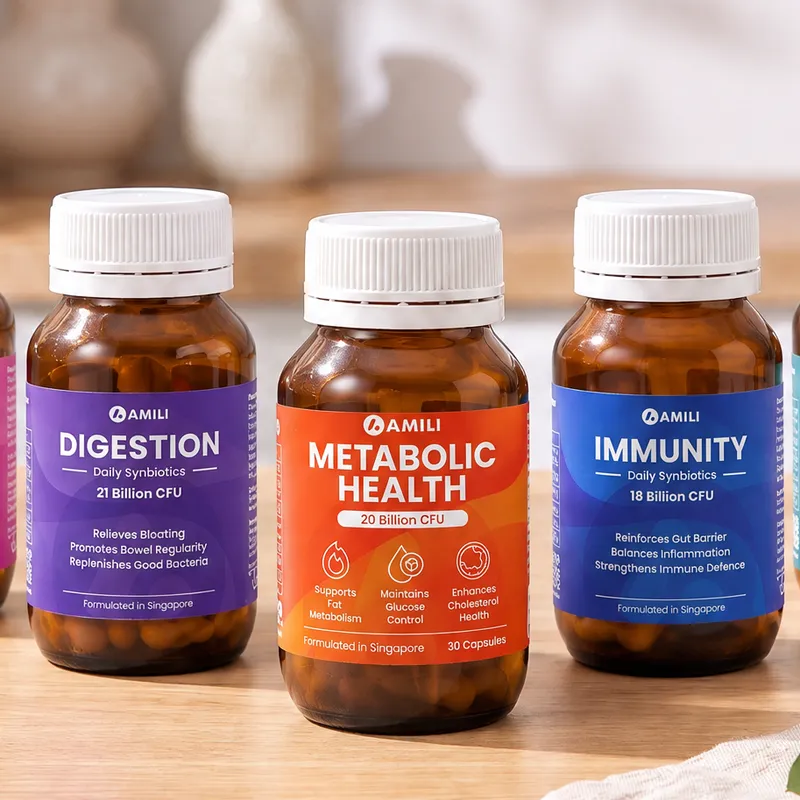
AMILI's Daily Synbiotics are sold on the AMILI website and at Unity pharmacies, and the Pro range is available only through AMILI's partner clinics.
Daily Synbiotics come in five formulations, Immunity, Complete, Mind & Brain, Digestion and Metabolic Health. Each is packed in nitrogen-flushed amber glass, which keeps out oxygen and light, in delayed-release capsules designed to pass through the stomach before opening. They are made to be stored at room temperature, so they do not need a chiller at the shop or at home. If you are not sure which suits you, GutMatch asks a few questions about your goals and suggests one. Browse Daily Synbiotics.
The Pro range is formulated for use with a doctor's guidance, for people whose doctor recommends more targeted support. It is sold only through AMILI's partner clinics, so you can find a partner clinic near you. Metabolic Health is available in both ranges.
Frequently asked questions
This article is for general information and does not replace advice from your doctor. Speak to a healthcare professional before making changes to your treatment.
Written

Written by
Yuzu Tay
Yuzu Tay is a science communicator trained in biomedical engineering. Her focus is on translating and sharing real science to help people make better decisions about their health.
View profile