Probiotic Supplements: What They Do and Who Actually Needs Them
Probiotic supplements deliver named live strains that act mostly while you take them. Evidence is strongest after antibiotics; strain decides the rest.
By Yuzu Tay
Updated 5 Nov 2026 · 13 min read


Key takeaways
- Probiotic supplements work strain by strain, so a benefit shown for one strain does not transfer to others with the same species name.
- The clearest evidence is for taking certain probiotics alongside antibiotics, where they lower the chance of diarrhoea, especially in children.
- For healthy adults, benefits are modest and specific, such as softer, more regular bowel movements, and most strains fade from the gut after you stop, because the bacteria already there resist newcomers.
- If you have a weakened immune system or a serious illness, check with your doctor before starting one.
- The most useful test is your own. Take one for four to eight weeks and note what changes.
Probiotic supplements deliver specific live bacteria in measured amounts, and most of them work while they pass through your gut over the weeks you take them. Whether you need one depends on your situation and on the strain. At the moment, the evidence is strongest for a few uses, such as during a course of antibiotics, and more modest for healthy adults. Before buying one, it helps to know what each strain on the label is for and what supplementation can do for you.
What do probiotic supplements do for gut health?
Probiotic supplements add live microorganisms that provide a health benefit when taken in adequate amounts, the definition first set out by the FAO and WHO in 2001 and kept by an international panel of scientists in 2014.1 In your gut, the bacteria interact with the microbes already living there and with immune cells in the gut lining, and they make acids and other compounds as they pass through. The same panel concluded that support for a healthy digestive tract is a benefit shared across many well-studied species, while effects on immunity depend more on the individual strain.1
Most strains do not settle, because the bacteria already in your gut compete with newcomers for food and space and, together with your gut lining, limit which strains can stay, which researchers call colonisation resistance.2 A review of 45 studies in healthy adults found that supplements raised levels of the strains they contained, and those levels tended to fall back after people stopped.3 In a study at the Weizmann Institute that sampled the gut lining directly, how well an 11-strain probiotic settled varied from person to person,2 and our article on whether Western probiotics work for guts in Asia explains why. The good news is that a strain does not need to settle to have an effect, since it can still interact with your resident bacteria and gut lining as it passes through.
The format a probiotic comes in also decides how many of its bacteria reach your gut alive, though reaching the gut does not guarantee they stay.
What are the benefits of probiotic supplements?
The best-documented benefits of probiotic supplements are for specific situations, and each comes from specific strains:
- Less diarrhoea during antibiotics. A Cochrane review of 33 trials in 6,352 children found that 8% of those given probiotics alongside antibiotics developed diarrhoea, against 19% of those without. Doses of at least 5 billion CFU a day worked better than lower doses.4 Lacticaseibacillus rhamnosus GG and the yeast Saccharomyces boulardii are the best-supported choices for children.5
- Bowel habits in healthy adults. The review of 45 studies in healthy adults found benefits for stool consistency and bowel movements, as well as immune responses and vaginal health. It found too little evidence for changes in blood fats or lasting changes in gut bacteria.3
These benefits come from particular strains, doses and groups of people. Evidence on probiotic foods such as yoghurt and fermented vegetables is broader and less certain, because whole-food studies cannot isolate one strain.
Should you take a probiotic supplement?
Whether you should take a probiotic supplement depends on why you want one. The evidence sorts into three situations:
- During a course of antibiotics. This is where the evidence is strongest. Ask your doctor or pharmacist which strain to take and when, because most trials gave probiotics alongside the antibiotic. One caution comes from a study in which an 11-strain probiotic taken after antibiotics settled easily but delayed the return of people's own gut bacteria for months.6 It was a single, small study, and it is a reason to choose a strain with trial evidence for this use.
- For a specific digestive symptom. Some strains have trials for symptoms such as bloating or irregular bowel movements, but results vary by strain and, for the same strain, from one country's trials to the next, as our comparison of trials across countries shows. The American Gastroenterological Association recommends probiotics for irritable bowel syndrome (IBS) only within clinical trials.7 If symptoms last more than a few weeks, see a doctor first.
- As a daily habit when you are healthy. Benefits are modest and specific. Fibre and fermented foods feed and add to your gut bacteria every day, and a supplement is the way to get named strains in a measured dose.
People with a weakened immune system, a serious illness, a central line or a baby born early should check with a doctor before taking any probiotic. Rare infections linked to probiotics have been reported, mainly in people who were severely ill or immunocompromised.8
What are researchers testing probiotics for next?
Researchers are now testing probiotics for uses well beyond digestion, using bacteria chosen for a specific job. Much of this work starts with gut sequencing studies, which compare the bacteria of people with and without a condition. When a bacterium is consistently lower in one group, or helps in mice, it becomes a candidate, and human trials follow years later. So the areas below sit at very different stages, from approved medicines to small early trials, and most are not yet a reason to start a supplement. They do show where the field is heading, and what kind of evidence to look for as new products reach the shelves.
Next-generation probiotics from bacteria native to the gut
Next-generation probiotics are gut bacteria with no long history in food, picked because research linked them to health. Akkermansia muciniphila is the best-known example. It lives in the mucus layer of the gut lining, and studies have found less of it in mice with obesity and type 2 diabetes, and lower levels have been linked to higher body weight in people.9 In a three-month pilot trial of 32 adults with overweight or obesity and insulin resistance, a pasteurised form was linked to better insulin sensitivity than placebo.10 In 2021, the European Food Safety Authority judged pasteurised Akkermansia safe as a novel food ingredient.11
Faecalibacterium prausnitzii is one of the main butyrate producers in the gut. Butyrate is a short-chain fatty acid that fuels the cells lining your colon. People with Crohn's disease tend to have less F. prausnitzii, and it reduced gut inflammation in mice.12 It dies quickly in oxygen, which makes it hard to manufacture, so human trials are still at an early stage.
Some gut bacteria are now regulated as medicines. In 2023, the US Food and Drug Administration approved Vowst, a capsule of purified bacterial spores from healthy donors' stool. It is given after antibiotic treatment to lower the chance of Clostridioides difficile infection coming back. In its main trial of 182 people, the infection returned within eight weeks in 12% of those taking the capsules and 40% of those taking placebo.13 This means the strongest results so far come from specific bacteria tested for a specific condition and prescribed by a doctor.
Stress, mood and the gut-brain connection
Strains studied for their effects on the brain, which researchers call psychobiotics, have shown promise in animals and more mixed results in people. Gut bacteria make compounds that can signal to the brain through the vagus nerve, the immune system and the blood, and in mice some strains changed how the animals responded to stress. In a small trial of 22 healthy men, Bifidobacterium longum 1714 was linked to lower reported stress and slightly better memory over four weeks.14 A strain of Lacticaseibacillus rhamnosus (JB-1) that reduced anxiety-like behaviour in mice had no effect on stress or thinking in a trial of healthy men.15
The gap between the two shows why a result in mice is only a starting point, and why the field needs larger trials in people. If you try a probiotic for stress or mood, judge it on yourself over several weeks, alongside sleep, exercise and other support. See a doctor for low mood that lasts.
Response to cancer treatment
Gut bacteria have been linked to how well some cancer treatments work, particularly immunotherapy, which helps the immune system attack tumours. In a 2018 study of people with lung and kidney cancer on immunotherapy, those who responded more often had Akkermansia muciniphila in their gut, and those who had recently taken antibiotics did worse.16
Early trials are now testing bacteria given alongside treatment. In a trial of 30 people with advanced kidney cancer, the cancer was controlled for longer in those given the Clostridium butyricum strain CBM588 with immunotherapy than in those on immunotherapy alone.17 One finding points the other way. In a study of people with melanoma, those taking over-the-counter probiotics tended to respond less well to immunotherapy, while those eating more fibre responded better. In mice, two common probiotic products weakened the treatment.18 So if you are having cancer treatment, check with your cancer care team before taking any probiotic.
Vaginal health
Vaginal health is one of the more advanced areas. A healthy vagina is usually dominated by lactobacilli, especially Lactobacillus crispatus. Bacterial vaginosis is a common imbalance in which these lactobacilli are replaced by other bacteria, and it often comes back after antibiotic treatment. In a trial of 228 women in the US who had just been treated for it, an L. crispatus strain (CTV-05) applied vaginally after treatment was linked to fewer recurrences. Within 12 weeks, it came back in 30% of those using the strain and 45% of those on placebo.19
That product is applied inside the vagina and is still in development, so its results do not carry over to probiotics taken by mouth. If you have symptoms, see a doctor first, because bacterial vaginosis needs diagnosis and treatment before anything else.
What does each strain on a probiotic label do?
Each strain on a probiotic label has its own research, so it helps to know what the common ones are studied for. In 2020, scientists split the genus Lactobacillus into 25 genera, so many familiar names changed, and labels may use either name.20 The strains you are most likely to see:
- Lactiplantibacillus plantarum (formerly Lactobacillus plantarum). Common in fermented vegetables. Strain 299v was linked to less abdominal pain and bloating than placebo in a four-week trial of 214 people with IBS in India.21
- Lacticaseibacillus rhamnosus (formerly Lactobacillus rhamnosus). Strain GG is one of the two best-supported probiotics for reducing diarrhoea in children taking antibiotics.4,5
- Lacticaseibacillus paracasei (formerly Lactobacillus paracasei). Includes strain Shirota, which was linked to fewer stress-related abdominal and cold symptoms in a trial in medical students facing exams, run with the company that makes it.22
- Limosilactobacillus reuteri (formerly Lactobacillus reuteri). Strain DSM 17938 reduced crying time in breastfed babies with colic in an analysis of four trials with 345 infants.23 The effect in formula-fed babies is unclear.
- Bifidobacterium longum. Found in people of all ages. Different strains have been studied for stress, low mood alongside IBS and IBS symptoms. Our article on Bifidobacterium longum benefits covers them.
- Bifidobacterium breve. One of the main bifidobacteria in babies, found in about 70% of children under three in a Japanese study.24
- Bifidobacterium animalis subsp. lactis. Found in only about one in nine people in the same study,24and it is better known as a culture added to fermented dairy and supplements. Strain HN019 shortened the time food takes to pass through the gut in a 14-day trial of 100 adults with digestive symptoms, funded by the companies that make it.25
- Streptococcus thermophilus. A yoghurt starter culture. Live yoghurt cultures are recognised in the EU for improving lactose digestion in people who digest lactose poorly.26 Some products, including AMILI's, add it in inactivated form as a postbiotic.
Do probiotic gummies, powders and other formats keep the strains alive?
Whether a probiotic gummy, powder or capsule keeps its strains alive depends on how well the format shields them from heat, moisture, oxygen and stomach acid, and on the strain itself. Most Lactobacillus and Bifidobacterium strains slowly die off from the day they are made, and faster when they are warm or damp, so makers add extra bacteria at manufacture to cover the losses.27 The main formats compare like this:
- Capsules and tablets. Both are dry, which helps bacteria survive storage, and blister packs or bottles with a drying sachet keep out moisture and air. Acid-resistant capsules are designed to stay closed in the stomach and open further along the gut.27
- Powders and sachets. Also dry, and a single-dose sachet keeps each serving sealed until you open it. Stir it into cool food or drink rather than hot, and take it straight away.
- Gummies. Gummies are cooked and hold more water than a capsule, which most Lactobacillus and Bifidobacterium strains tolerate poorly. Many gummies therefore use spore-forming strains such as Heyndrickxia coagulans (formerly Bacillus coagulans), which survive heat and drying in a dormant, tough-coated form and become active again in the gut.28 In a study of 24 healthy adults, spores of one strain given in a gummy every day for two weeks germinated in the gut of every participant, and the gummies kept their labelled count over 24 months.29 It tested one strain in a gummy made for the study, so it does not show that other gummies perform the same way.
- Liquids, drops and gels. Water lets bacteria stay active and run down their reserves, so many of these keep the bacteria suspended in oil, need refrigeration, or hold them in a separate dry compartment that you release just before taking it.
Whatever the format, not every product delivers what its label says. Of 52 probiotic supplements bought from shops in the United States, 17 held fewer live bacteria than their labels stated, before their expiry dates.30 Five checks on the label and packaging tell you how well a product is likely to protect its strains:
- A count guaranteed until the expiry date. Look for CFU "at expiry" or "through the end of shelf life" rather than "at time of manufacture", because counts fall during storage.31
- Full strain names. Each strain should be listed by genus, species and strain code, such as L. rhamnosus GG, so you can match it to the research.31
- Storage instructions that fit the format. A product that needs refrigeration should say so. In Singapore's heat and humidity, keep shelf-stable products somewhere cool and dry, with the lid closed.
- Protective packaging. Blister packs, sealed sachets and bottles with a drying sachet keep out the moisture and air that shorten shelf life.
- Testing in the format you buy. Ask the brand whether it has tested the count over the product's shelf life, and whether its strains survive stomach acid in this format. Results from an independent laboratory carry more weight than a brand's own figures.
A product that names its strains, guarantees its count to the expiry date and tells you how to store it gives you enough to judge it, whatever shape it comes in.
Which probiotic supplement should you start with?
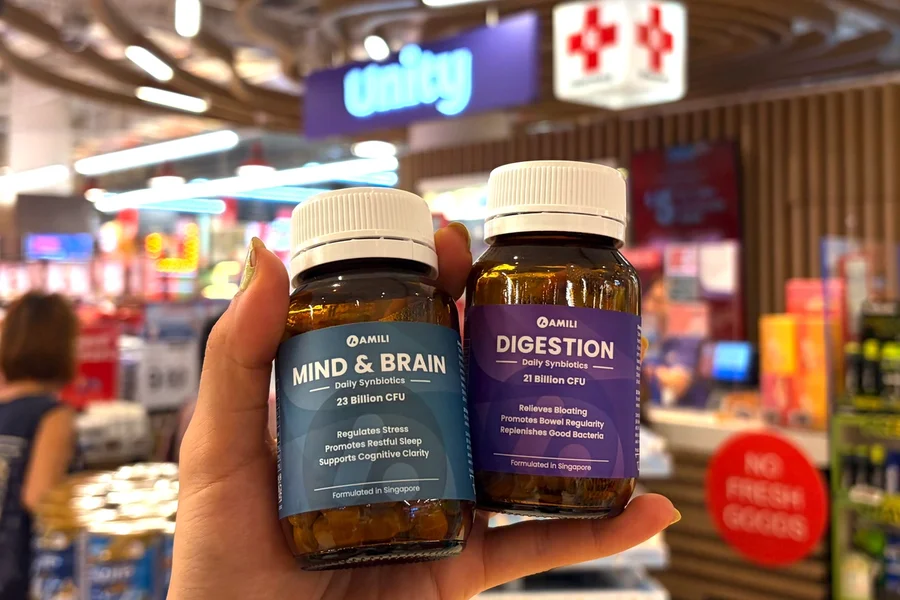
First, figure out what you want help with, then match a probiotic to it. AMILI's Daily Synbiotics are five formulas, each pairing selected probiotic strains with prebiotics and a postbiotic in a targeted-release capsule:
- Immunity Daily Synbiotics. Helps support the body's natural defences from the gut. Led by B. animalis subsp. lactis and L. plantarum, with B. longum. Suitable from age three.
- Complete Daily Synbiotics. Helps support everyday digestion, immunity, energy and mood in one capsule, with four live strains including B. longum and B. breve.
- Mind & Brain Daily Synbiotics. Designed around the gut-brain connection, with L. paracasei, a species studied for its role in stress.
- Digestion Daily Synbiotics. Helps support comfortable digestion and bowel regularity, with L. reuteri.
- Metabolic Health. Designed for metabolic support, with pasteurised Akkermansia muciniphila.
Every formula is made using AMILI's gut microbiome data from Asia. The strains in these formulas have not been tested in the trials described above, and like most probiotics, they are likely to act mainly while you take them, so give one four to eight weeks at 1 to 3 capsules daily and judge the result on yourself. If you are unsure which suits you, GutMatch asks a few questions about how you eat, live and feel, and suggests a formula in about two minutes. Compare the five formulas.
Frequently asked questions
References
- 1.Hill, Colin, et al. "Expert Consensus Document: The International Scientific Association for Probiotics and Prebiotics Consensus Statement on the Scope and Appropriate Use of the Term Probiotic." Nature Reviews Gastroenterology & Hepatology, vol. 11, no. 8, 2014, pp. 506–514. doi:10.1038/nrgastro.2014.66.
- 2.Zmora, Niv, et al. "Personalized Gut Mucosal Colonization Resistance to Empiric Probiotics Is Associated with Unique Host and Microbiome Features." Cell, vol. 174, no. 6, 2018, pp. 1388–1405.e21. doi:10.1016/j.cell.2018.08.041.
- 3.Khalesi, Saman, et al. "A Review of Probiotic Supplementation in Healthy Adults: Helpful or Hype?" European Journal of Clinical Nutrition, vol. 73, no. 1, 2019, pp. 24–37. doi:10.1038/s41430-018-0135-9.
- 4.Guo, Qin, et al. "Probiotics for the Prevention of Pediatric Antibiotic-Associated Diarrhea." Cochrane Database of Systematic Reviews, no. 4, 2019, CD004827. doi:10.1002/14651858.CD004827.pub5.
- 5.Yan, Tyler, and Ran D. Goldman. "Probiotics for Antibiotic-Associated Diarrhea in Children." Canadian Family Physician, vol. 66, no. 1, 2020, pp. 37–39.
- 6.Suez, Jotham, et al. "Post-Antibiotic Gut Mucosal Microbiome Reconstitution Is Impaired by Probiotics and Improved by Autologous FMT." Cell, vol. 174, no. 6, 2018, pp. 1406–1423.e16. doi:10.1016/j.cell.2018.08.047.
- 7.Su, Grace L., et al. "AGA Clinical Practice Guidelines on the Role of Probiotics in the Management of Gastrointestinal Disorders." Gastroenterology, vol. 159, no. 2, 2020, pp. 697–705. doi:10.1053/j.gastro.2020.05.059.
- 8.Doron, Shira, and David R. Snydman. "Risk and Safety of Probiotics." Clinical Infectious Diseases, vol. 60, suppl. 2, 2015, pp. S129–S134. doi:10.1093/cid/civ085.
- 9.Everard, Amandine, et al. "Cross-Talk between Akkermansia muciniphila and Intestinal Epithelium Controls Diet-Induced Obesity." Proceedings of the National Academy of Sciences, vol. 110, no. 22, 2013, pp. 9066–9071. doi:10.1073/pnas.1219451110.
- 10.Depommier, Clara, et al. "Supplementation with Akkermansia muciniphila in Overweight and Obese Human Volunteers: A Proof-of-Concept Exploratory Study." Nature Medicine, vol. 25, no. 7, 2019, pp. 1096–1103. doi:10.1038/s41591-019-0495-2.
- 11.EFSA Panel on Nutrition, Novel Foods and Food Allergens. "Safety of Pasteurised Akkermansia muciniphila as a Novel Food Pursuant to Regulation (EU) 2015/2283." EFSA Journal, vol. 19, no. 9, 2021, e06780. doi:10.2903/j.efsa.2021.6780.
- 12.Sokol, Harry, et al. "Faecalibacterium prausnitzii Is an Anti-Inflammatory Commensal Bacterium Identified by Gut Microbiota Analysis of Crohn Disease Patients." Proceedings of the National Academy of Sciences, vol. 105, no. 43, 2008, pp. 16731–16736. doi:10.1073/pnas.0804812105.
- 13.Feuerstadt, Paul, et al. "SER-109, an Oral Microbiome Therapy for Recurrent Clostridioides difficile Infection." New England Journal of Medicine, vol. 386, no. 3, 2022, pp. 220–229. doi:10.1056/NEJMoa2106516.
- 14.Allen, Andrew P., et al. "Bifidobacterium longum 1714 as a Translational Psychobiotic: Modulation of Stress, Electrophysiology and Neurocognition in Healthy Volunteers." Translational Psychiatry, vol. 6, no. 11, 2016, e939. doi:10.1038/tp.2016.191.
- 15.Kelly, John R., et al. "Lost in Translation? The Potential Psychobiotic Lactobacillus rhamnosus (JB-1) Fails to Modulate Stress or Cognitive Performance in Healthy Male Subjects." Brain, Behavior, and Immunity, vol. 61, 2017, pp. 50–59. doi:10.1016/j.bbi.2016.11.018.
- 16.Routy, Bertrand, et al. "Gut Microbiome Influences Efficacy of PD-1-Based Immunotherapy against Epithelial Tumors." Science, vol. 359, no. 6371, 2018, pp. 91–97. doi:10.1126/science.aan3706.
- 17.Dizman, Nazli, et al. "Nivolumab plus Ipilimumab with or without Live Bacterial Supplementation in Metastatic Renal Cell Carcinoma: A Randomized Phase 1 Trial." Nature Medicine, vol. 28, no. 4, 2022, pp. 704–712. doi:10.1038/s41591-022-01694-6.
- 18.Spencer, Christine N., et al. "Dietary Fiber and Probiotics Influence the Gut Microbiome and Melanoma Immunotherapy Response." Science, vol. 374, no. 6575, 2021, pp. 1632–1640. doi:10.1126/science.aaz7015.
- 19.Cohen, Craig R., et al. "Randomized Trial of Lactin-V to Prevent Recurrence of Bacterial Vaginosis." New England Journal of Medicine, vol. 382, no. 20, 2020, pp. 1906–1915. doi:10.1056/NEJMoa1915254.
- 20.Zheng, Jinshui, et al. "A Taxonomic Note on the Genus Lactobacillus: Description of 23 Novel Genera, Emended Description of the Genus Lactobacillus Beijerinck 1901, and Union of Lactobacillaceae and Leuconostocaceae." International Journal of Systematic and Evolutionary Microbiology, vol. 70, no. 4, 2020, pp. 2782–2858. doi:10.1099/ijsem.0.004107.
- 21.Ducrotté, Philippe, et al. "Clinical Trial: Lactobacillus plantarum 299v (DSM 9843) Improves Symptoms of Irritable Bowel Syndrome." World Journal of Gastroenterology, vol. 18, no. 30, 2012, pp. 4012–4018. doi:10.3748/wjg.v18.i30.4012.
- 22.Kato-Kataoka, Akito, et al. "Fermented Milk Containing Lactobacillus casei Strain Shirota Prevents the Onset of Physical Symptoms in Medical Students under Academic Examination Stress." Beneficial Microbes, vol. 7, no. 2, 2016, pp. 153–156. doi:10.3920/BM2015.0100.
- 23.Sung, Valerie, et al. "Lactobacillus reuteri to Treat Infant Colic: A Meta-analysis." Pediatrics, vol. 141, no. 1, 2018, e20171811. doi:10.1542/peds.2017-1811.
- 24.Kato, Kumiko, et al. "Age-Related Changes in the Composition of Gut Bifidobacterium Species." Current Microbiology, vol. 74, no. 8, 2017, pp. 987–995. doi:10.1007/s00284-017-1272-4.
- 25.Waller, Philip A., et al. "Dose-Response Effect of Bifidobacterium lactis HN019 on Whole Gut Transit Time and Functional Gastrointestinal Symptoms in Adults." Scandinavian Journal of Gastroenterology, vol. 46, no. 9, 2011, pp. 1057–1064. doi:10.3109/00365521.2011.584895.
- 26.EFSA Panel on Dietetic Products, Nutrition and Allergies. "Scientific Opinion on the Substantiation of Health Claims Related to Live Yoghurt Cultures and Improved Lactose Digestion." EFSA Journal, vol. 8, no. 10, 2010, p. 1763. doi:10.2903/j.efsa.2010.1763.
- 27.Fenster, Kurt, et al. "The Production and Delivery of Probiotics: A Review of a Practical Approach." Microorganisms, vol. 7, no. 3, 2019, p. 83. doi:10.3390/microorganisms7030083.
- 28.Cutting, Simon M. "Bacillus Probiotics." Food Microbiology, vol. 28, no. 2, 2011, pp. 214–220. doi:10.1016/j.fm.2010.03.007.
- 29.Perotti, Susanna, et al. "Human In Vivo Assessment of the Survival and Germination of Heyndrickxia coagulans SNZ1969 Spores Delivered via Gummy Candies." Current Research in Food Science, vol. 9, 2024, p. 100793. doi:10.1016/j.crfs.2024.100793.
- 30.Morovic, Wesley, et al. "Genotyping by PCR and High-Throughput Sequencing of Commercial Probiotic Products Reveals Composition Biases." Frontiers in Microbiology, vol. 7, 2016, p. 1747. doi:10.3389/fmicb.2016.01747.
- 31.Binda, Sylvie, et al. "Criteria to Qualify Microorganisms as 'Probiotic' in Foods and Dietary Supplements." Frontiers in Microbiology, vol. 11, 2020, p. 1662. doi:10.3389/fmicb.2020.01662.
- 32.Gibson, Glenn R., et al. "Expert Consensus Document: The International Scientific Association for Probiotics and Prebiotics (ISAPP) Consensus Statement on the Definition and Scope of Prebiotics." Nature Reviews Gastroenterology & Hepatology, vol. 14, no. 8, 2017, pp. 491–502. doi:10.1038/nrgastro.2017.75.
- 33.Salminen, Seppo, et al. "The International Scientific Association of Probiotics and Prebiotics (ISAPP) Consensus Statement on the Definition and Scope of Postbiotics." Nature Reviews Gastroenterology & Hepatology, vol. 18, no. 9, 2021, pp. 649–667. doi:10.1038/s41575-021-00440-6.
- 34.Whorwell, Peter J., et al. "Efficacy of an Encapsulated Probiotic Bifidobacterium infantis 35624 in Women with Irritable Bowel Syndrome." American Journal of Gastroenterology, vol. 101, no. 7, 2006, pp. 1581–1590. doi:10.1111/j.1572-0241.2006.00734.x.
This article is for general information and does not replace advice from your doctor. Speak to a healthcare professional before making changes to your treatment.
Written

Written by
Yuzu Tay
Yuzu Tay is a science communicator trained in biomedical engineering. Her focus is on translating and sharing real science to help people make better decisions about their health.
View profile