Association between exercise, nutrient and food with the Singaporean gut microbial composition
In this paper, we investigated the relationship between exercise, nutrient and food with the Singaporean gut microbial composition.
By Amili team
Updated 8 Jan 2022 · 2 min read


Tan, S.-C., Toh, K. Y., Ho, J.-P., et al. (2021). IDDF2021-ABS-0169: The association between exercise, nutrient and food habits with the Singaporean gut microbial composition. Gut, 70(Suppl. 2), A3–A3. https://doi.org/10.1136/gutjnl-2021-IDDF.3
BACKGROUND
The impact of non-dietary lifestyle factors on the gut microbiota, such as physical activity, has not been frequently reported. Recent studies have suggested that exercise can increase the number of beneficial microbial species which enhance short-chain fatty acid synthesis and carbohydrate metabolism. Therefore, we investigated the relationship between physical activity and gut microbiome composition within a cohort of multi-ethnic healthy Singaporeans.
METHODS
257 individuals completed the Global Physical Activity Questionnaire (GPAQ) (Armstrong et al. 2006) and Food Frequency Questionnaire (FFQ) (Whitton et al. 2017), to obtain quantitative measures of their physical activity, nutrition and dietary habits, respectively. They also provided paired stool samples, which underwent 16S rRNA V3-4 amplicon sequencing. Community and individual microbial features associated with physical activity were assessed using microbial ecology measures such as α-diversity and principal coordinate analysis (PCA), as well as, multivariate sparse Partial Least Squares analyses, whilst confounding for nutritional and dietary habits.
RESULTS
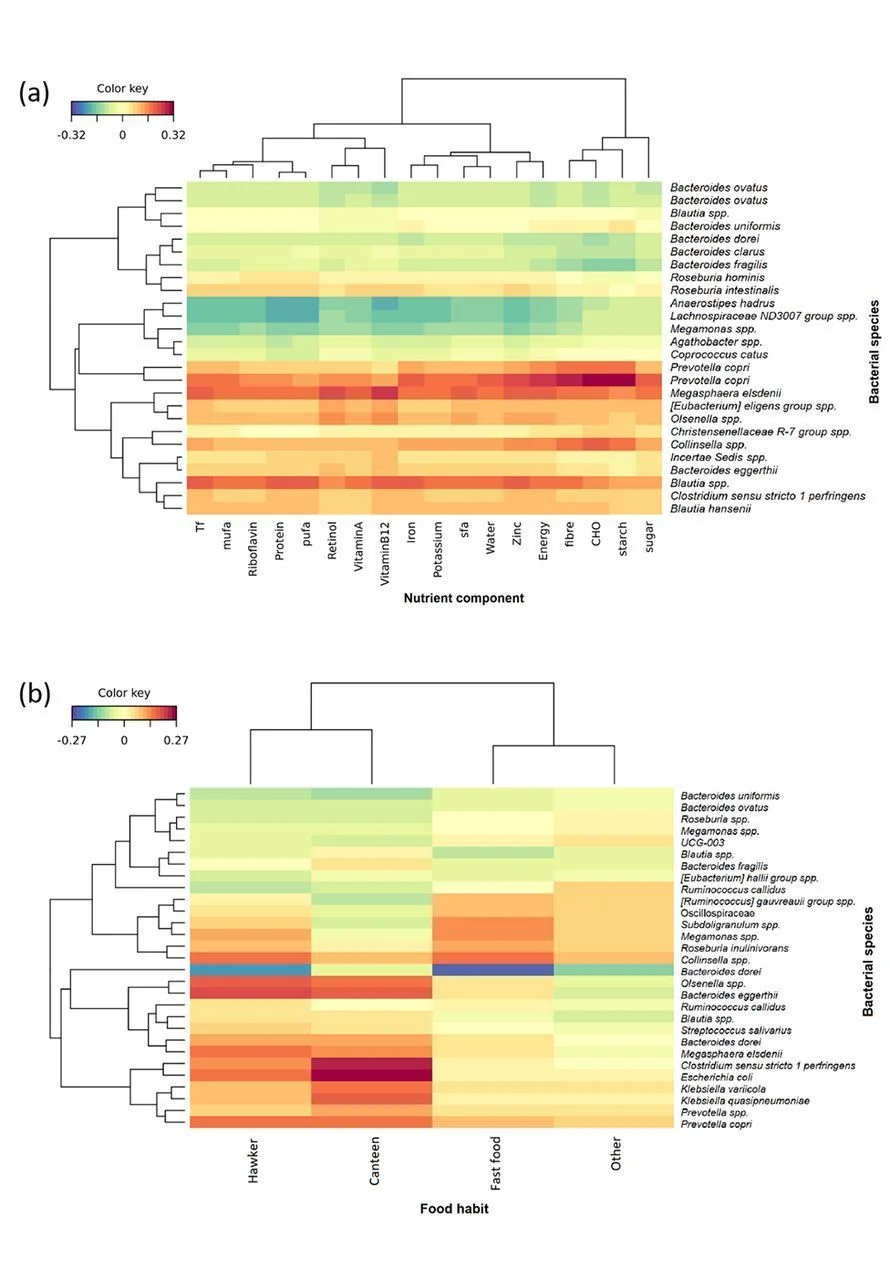
Using the GPAQ, 57% of the individuals were deemed to have an active lifestyle. Active individuals have increased microbial α-diversity, although not statistically significant. Unsupervised PCA analysis identified a subset of active individuals with distinct microbiome signatures, whereby these individuals, compared to those with sedentary lifestyles, have increased abundances of Prevotella spp., which is in keeping with their increased fibre intake. Sedentary lifestyle individuals were found to have increased abundance of Lachnoclostridium spp., whereby phylogenetic similar microbial features (such as Roseburia and Subdoligranulum spp.) were significantly correlated with more frequent eating out at hawker stalls and fast-food establishments (IDDF2021-ABS-0169 Figure 1. Correlation between gut microbiome with (a) nutrient intake; and (b) food habit). Studying the metabolic potential of the microbiome, active individuals had increased abundances of gene content related to energy production, whereby sedentary individuals had increased abundances of gene content related to degradation of aromatic compounds.
This article is for general information and does not replace advice from your doctor. Speak to a healthcare professional before making changes to your treatment.
Written
Written by
Amili team