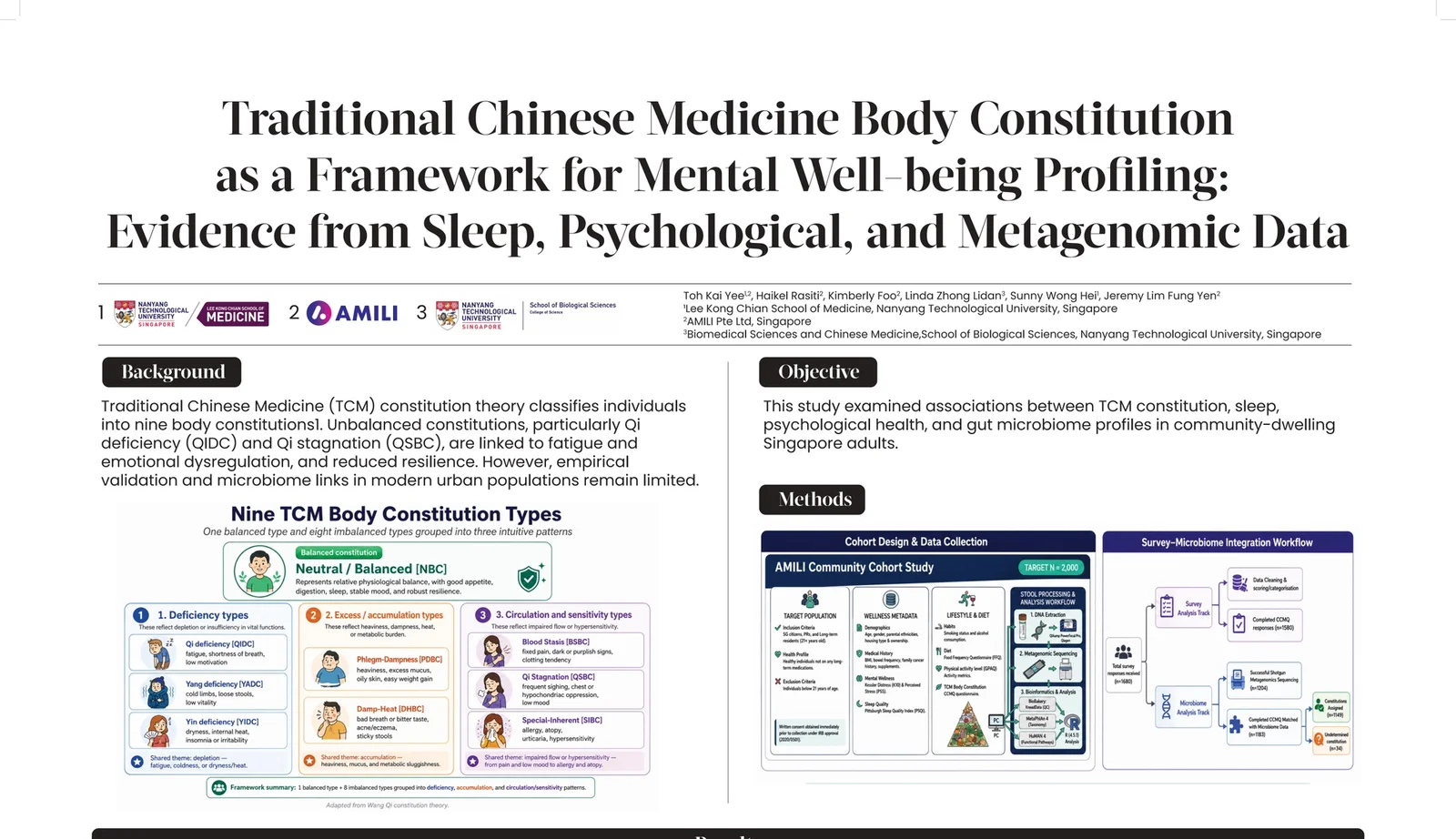
Traditional Chinese Medicine Body Constitution as a Framework for Mental Well-being Profiling
20th Singapore Public Health & Occupational Medicine Conference
By Amili team
Updated 16 Nov 2026 · 2 min read


Toh Kai Yee, Haikel Rasiti, Kimberly Foo, Linda Zhong Lidan, Sunny Wong Hei, Jeremy Lim Fung Yen
Lee Kong Chian School of Medicine, Nanyang Technological University, Singapore
AMILI Pte Ltd, Singapore
Biomedical Sciences and Chinese Medicine, School of Biological Sciences
Nanyang Technological University, Singapore
BACKGROUND
Traditional Chinese Medicine (TCM) constitution theory classifies individuals into nine body constitutions. Unbalanced constitutions, particularly Qi deficiency (QIDC) and Qi stagnation (QSBC), are linked to fatigue and emotional dysregulation, and reduced resilience. However, empirical validation and microbiome links in modern urban populations remain limited.
OBJECTIVE
This study examined associations between TCM constitution, sleep, psychological health, and gut microbiome profiles in community-dwelling Singapore adults.
RESULTS
- Alpha diversity: No significant differences in microbial richness or evenness were observed across the primary constitution groups.
- Beta diversity: Constitution was associated with small but statistically significant differences in overall microbial composition after adjustment for age, gender and BMI (Aitchison and Jaccard PERMANOVA: p = 0.001; R² ≈ 0.012).
- Differential abundance: Adjusted MaAsLin2 analysis identified constitution-specific species associations.
- QIDC showed the most distinct pattern, characterised by lower relative abundance of several fibre-utilising or SCFA-associated anaerobes, including Lachnospira eligens, and higher relative abundance of selected opportunistic or pathobiont-associated taxa, including Enterocloster bolteae (q < 0.05).
Body constitution was associated with psychological well-being and sleep quality, consistent with the vitality and emotional traits described in TCM theory.
- Perceived stress: Moderate association with constitution type (p < 0.001; Cramér’s V = 0.323).
- Psychological distress: Strongest observed association (p < 0.001; Cramér’s V = 0.335).
- Sleep quality: Significant but comparatively weaker association (p < 0.001; Cramér’s V = 0.172).
Compared with NBC, several unbalanced constitutions showed higher proportions of moderate-to-high stress, psychological distress and poor-to-severe sleep.
- QSBC exhibited the highest psychological burden, with approximately 96% reporting moderate-to-high perceived stress and 92% reporting at least mild psychological distress (n=48; smallest subgroup, interpret with caution).
- BSBC and QSBC also showed the highest proportions of severe sleep impairment.
LIMITATIONS & STRENGTH
Strengths: One of the largest Southeast Asian evaluations of constitution-related sleep and psychological profiles, using a robust, covariate-adjusted, and gender-stratified community cohort.
Limitations: Cross-sectional design limits causal claims, while self-reporting introduces bias. Unequal group sizes and multiple testing affect precision, and the healthy, predominantly Chinese sample limits generalisability across Singapore.
CONCLUSIONS
TCM constitution was significantly associated with sleep, psychological well-being, and gut microbiome signatures in community-dwelling Singapore adults, supporting its potential as a culturally relevant framework for at-risk profiling, though the cross-sectional design necessitates a cautious, potentially bi-directional interpretation of these associations.
This article is for general information and does not replace advice from your doctor. Speak to a healthcare professional before making changes to your treatment.
Written
Written by
Amili team