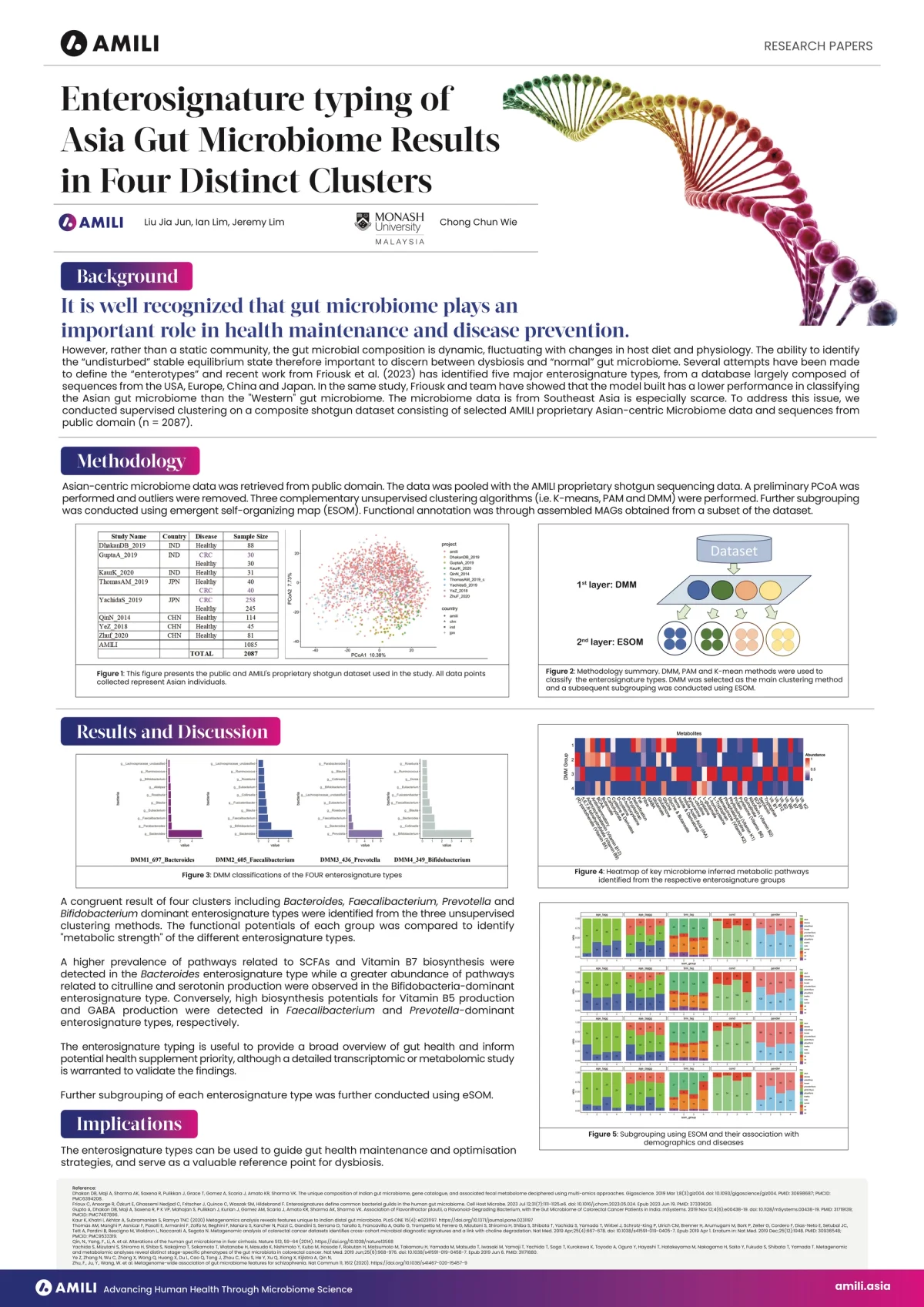
Enterosignature typing of Asia gut microbiome results in four distinct clusters
Enterosignature typing of Asia gut microbiome results in four distinct clusters
Liu, J. J., Lim, I., Lim, J., & Chong, C. W. (2024). Enterosignature typing of Asia gut microbiome results in four distinct clusters [Poster presentation]. 9th Microbiome R&D and Business Collaboration Congress.
BACKGROUND
It is well recognized that gut microbiome plays an important role in health maintenance and disease prevention.
However, rather than a static community, the gut microbial composition is dynamic, fluctuating with changes in host diet and physiology. The ability to identify the "undisturbed" stable equilibrium state therefore important to discern between dysbiosis and "normal" gut microbiome. Several attempts have been made to define the "enterotypes" and recent work from Friousk et al. (2023) has identified five major enterosignature types, from a database largely composed of sequences from the USA, Europe, China and Japan. In the same study, Friousk and team have showed that the model built has a lower performance in classifying the Asian gut microbiome than the "Western" gut microbiome. The microbiome data is from Southeast Asia is especially scarce. To address this issue, we conducted supervised clustering on a composite shotgun dataset consisting of selected AMILI proprietary Asian-centric Microbiome data and sequences from public domain (n = 2087).
METHODOLOGY
Asian-centric microbiome data was retrieved from public domain. The data was pooled with the AMILI proprietary shotgun sequencing data. A preliminary PCoA was performed and outliers were removed. Three complementary unsupervised clustering algorithms (i.e. K-means, PAM and DMM) were performed. Further subgrouping was conducted using emergent self-organizing map (ESOM). Functional annotation was through assembled MAGs obtained from a subset of the dataset. DMM, PAM and K-mean methods were used to classify the enterosignature types. DMM was selected as the main clustering method and a subsequent subgrouping was conducted using ESOM.
RESULTS
A congruent result of four clusters including Bacteroides, Faecalibacterium, Prevotella and Bifidobacterium dominant enterosignature types were identified from the three unsupervised clustering methods. The functional potentials of each group was compared to identify "metabolic strength" of the different enterosignature types.
A higher prevalence of pathways related to SCFAs and Vitamin B7 biosynthesis were detected in the Bacteroides enterosignature type while a greater abundance of pathways related to citrulline and serotonin production were observed in the Bifidobacteria-dominant enterosignature type. Conversely, high biosynthesis potentials for Vitamin B5 production and GABA production were detected in Faecalibacterium and Prevotella-dominant enterosignature types, respectively.
The enterosignature typing is useful to provide a broad overview of gut health and inform potential health supplement priority, although a detailed transcriptomic or metabolomic study is warranted to validate the findings.
Further subgrouping of each enterosignature type was further conducted using eSOM.
IMPLICATIONS
The enterosignature types can be used to guide gut health maintenance and optimisation strategies, and serve as a valuable reference point for dysbiosis.