A comparative study of metagenomic kit for low-input microbiome DNA
Limits of detection: A comparative study of metagenomic kit for low-input microbiome DNA
Chan, E., Lin, M., Lim, L., & Toh, K. Y. (2025). Limits of detection: A comparative study of metagenomic kit for low-input microbiome DNA [Poster presentation]. 10th Microbiome R&D and Business Collaboration Congress.
Shotgun metagenomic studies in low-biomass microbiome samples, such as saliva, vaginal, and urine, are becoming increasingly common.
A key challenge, however, is that these studies require efficient library preparation with minimal amplification bias, but standard sequencing workflows often requires at least 20ng of input DNA, an amount often unavailable in such samples. Despite the widespread use of kits like NEBNExt® Ultra™ II, TruSeq DNA Nano, Illumina DNA prep for low-input DNA, their performance for consistent sequencing read-outs at ultra-low DNA inputs (e.g. 0.1ng) has not been thoroughly investigated.
AIM
To evaluate the performance of four DNA sequencing library preparation kits - Illumina (TruSeq DNA Nano and Illumina DNA Prep), NEB (NEBNExt® Ultram II) and Micronbrane (Unison Ultralow) - across a range of input DNA amount (100ng to 0.01ng), with a focus on consistency, sensitivity and taxonomic fidelity.
METHODS
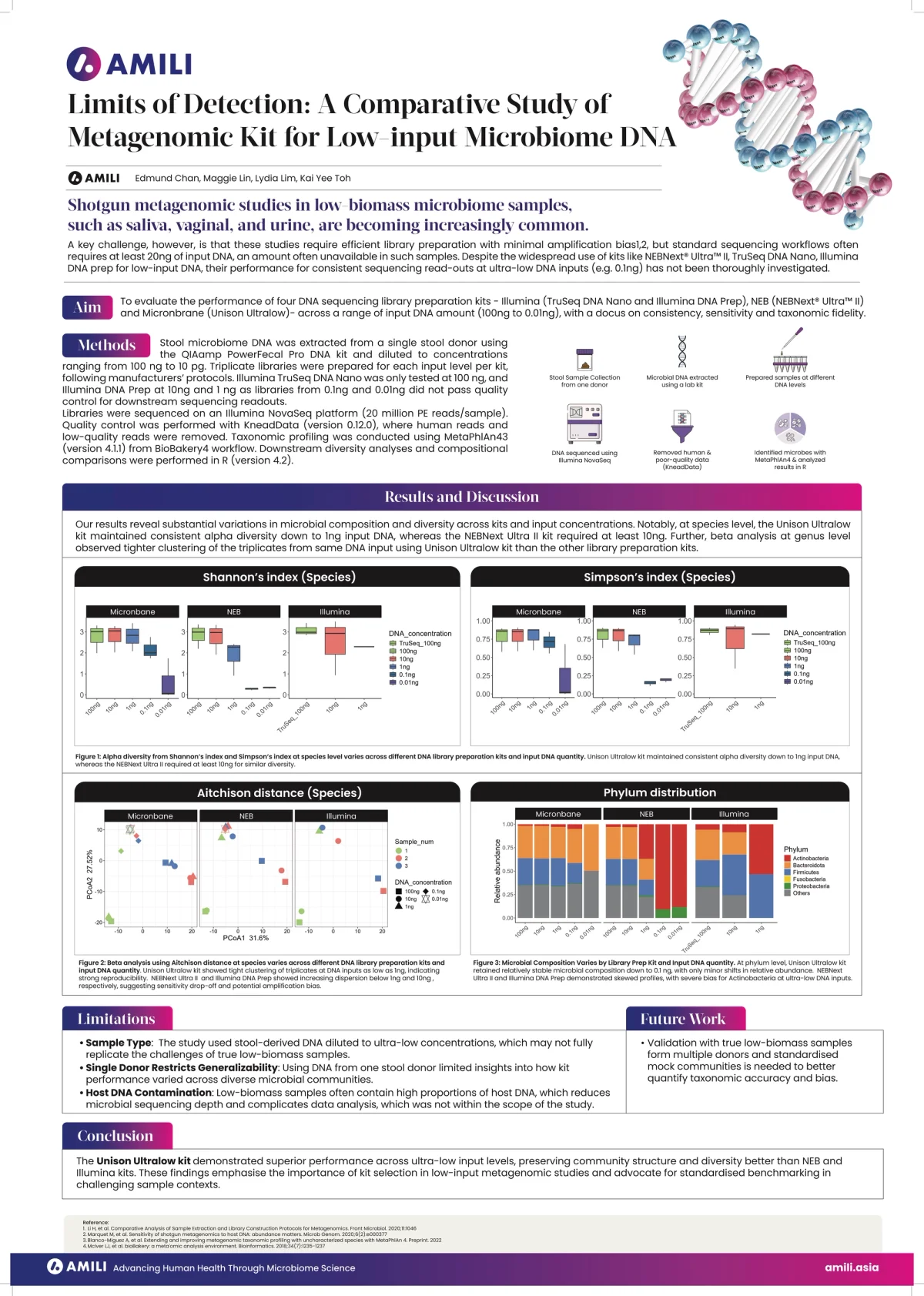
Stool microbiome DNA was extracted from a single stool donor using the QIAamp PowerFecal Pro DNA kit and diluted to concentrations ranging from 100 ng to 10 pg. Triplicate libraries were prepared for each input level per kit, following manufacturers' protocols. Illumina TruSeq DNA Nano was only tested at 100 ng, and Illumina DNA Prep at 10ng and 1ng. All libraries from 0.1ng and 0.01ng did not pass quality control for downstream sequencing readouts.
Libraries were sequenced on an Illumina NovaSeq platform (20 million PE reads/sample). Quality control was performed with KneadData (version 0.12.0), where human reads and low-quality reads were removed. Taxonomic profiling was conducted using MetaPhlAn43 (version 4.1.1) from BioBakker. Downstream diversity analyses and compositional comparisons were performed in R (version 4.2).
RESULTS AND DISCUSSION
Our results reveal substantial variations in microbial composition and diversity across kits and input concentrations. Notably, at species level, the Unison Ultralow kit maintained consistent alpha diversity down to 1ng input DNA, whereas the NEBNext Ultra II kit required at least 10ng. Further, beta analysis at genus level observed tighter clustering of the triplicates from same DNA input using Unison Ultralow kit than the other library preparation kits.
Alpha diversity from Shannon's index and Simpson's index at species level varies across different DNA library preparation kits and input DNA quantity. Unison Ultralow kit maintained consistent alpha diversity down to low input DNA, whereas the NEBNext Ultra II required at least 10ng for similar diversity.
Beta analysis using Aitchison distance at species varies across different DNA library preparation kits and input DNA quantity. Unison Ultralow kit showed tight clustering of triplicates at DNA inputs as low as 1ng, indicating strong reproducibility. NEBNext Ultra II and Illumina DNA Prep showed increasing dispersion below 10ng and 10ng, respectively, suggesting sensitivity drop-off and potential amplification bias.
Microbial Composition Varies by Library Prep Kit and Input DNA quantity. At phylum level, Unison Ultralow kit retained relatively stable microbial composition down to 0.1 ng, with only minor shifts in relative abundance. NEBNext Ultra II and Illumina DNA Prep demonstrated skewed profiles, with severe bias for Actinobacteria at ultra-low DNA inputs.
LIMITATIONS
- Sample Type: The study used stool-derived DNA diluted to ultra-low concentrations, which may not fully replicate the challenges of true low-biomass samples.
- Single Donor Restricts Generalizability: Using DNA from one stool donor limited insights into how kit performance varied across diverse microbial communities.
- Host DNA Contamination: Low-biomass samples often contain high proportions of host DNA, which reduces microbial sequencing depth and complicates data analysis, which was not within the scope of the study.
FUTURE WORK
Validation with true low-biomass samples from multiple donors and standardised mock communities is needed to better quantify taxonomic accuracy and bias.
CONCLUSION
The Unison Ultralow kit demonstrated superior performance across ultra-low input levels, preserving community structure and diversity better than NEB and Illumina kits. These findings emphasise the importance of kit selection in low-input metagenomic studies and advocate for standardised benchmarking in challenging sample contexts.