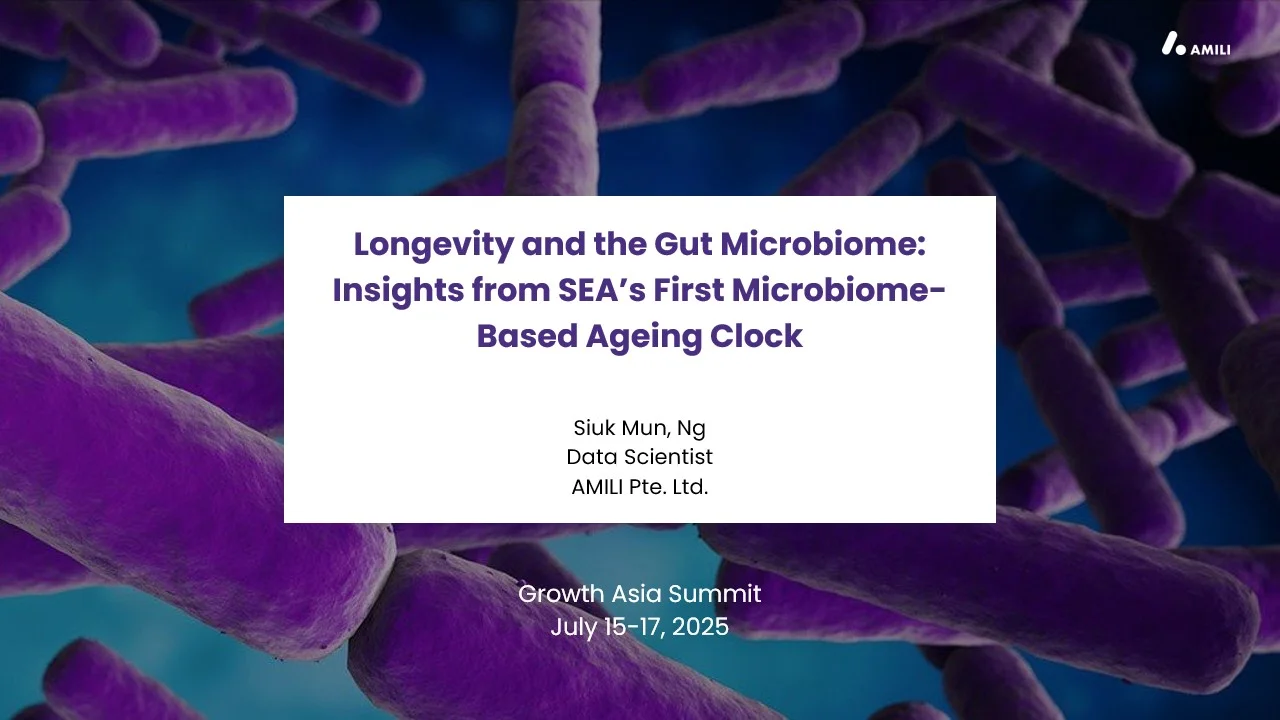
Longevity and the Gut Microbiome: Insights from SEA’s First Microbiome-Based Ageing Clock
Growth Asia Summit, July 15-17, 2025
By Amili team
Updated 16 Nov 2026 · 1 min read
Share


BACKGROUND
- Chronological age: The number of years an individual has lived since birth
- Biological age: The years that reflect an individual’s physical condition and how well their body functions
If Biological age < Chronological age: Better health, longevity and resilience to diseases. If Biological age > Chronological age: Higher risk of chronic diseases, accelerated aging.
Gut microbiome: a window into aging
Aging clock is a predictive model that estimates biological age using age-related biomarkers.
Why Microbiome?
- Microbial composition and function change with age
- Effects of dysbiosis on aging and age-related diseases
- Predictive of health outcomes like frailty and mortality risk
- Potential to guide personalized interventions for slow aging
MODEL DESIGN AND PERFORMANCE
We developed an Asian-centric gut microbiome aging clock using 16S rRNA data.
CROSS-COHORT VALIDATION
SUMMARY
- Gut microbiome changes with age: reveals personalized biological age which reflects health status, disease risk, lifestyle impact, etc.
- Gut microbiome age tells health-related aging dynamics: distinguishes between accelerated or decelerated aging based on gut microbial profiles
- Population specific modeling: offers high accuracy and generalizability across different cohorts
This article is for general information and does not replace advice from your doctor. Speak to a healthcare professional before making changes to your treatment.
Written
Written by
Amili team