Understanding Public and Physicians’ Knowledge, Awareness and Perceptions of FMT (MRT)
Understanding Public and Physicians’ Knowledge, Awareness and Perceptions of Fecal Microbiota Transplant
Lee, S. Y., Soh, A., Ong, D., Toh, K. Y., Lim, L. W. Z., Cook, A. R., Lim, J., & Lee, J. (2023). Understanding public and physicians’ knowledge, awareness and perceptions of fecal microbiota transplant [Poster presentation]. Digestive Disease Week 2023.
INTRODUCTION
Fecal microbiota transplant (FMT) is a highly effective therapy for recurrent or refractory Clostridioides difficile infections (CDI) with reported successful treatment in up to 90% of patients. Despite the inclusion of FMT for treatment of CDI in professional society guidelines, the uptake of FMT therapy has been variable, particularly in South East Asia. We hypothesize that physician and patient attitudes may be a barrier to the uptake of FMT. Data regarding public and physician knowledge and awareness of gut microbiome and FMT, in particularly in South East Asia, are limited.
AIM
We aim to access South East Asian physicians’ and Singaporean public awareness regarding FMT and gut microbiome.
METHOD
Our study, consisting of two parts, was conducted from August 2020 to July 2021. First, one survey of 19 multiple choice questions was made available online for 10 days to 50,000 participants of the Singapore Population Health Studies Online Panel, managed by the National University of Singapore, Saw Swee Hock School of Public Health. Explanations of the gut microbiome and FMT process were provided when applicable. Participants were then asked questions regarding their existing knowledge and perception about
these topics. Second, another survey of 21 questions was made available online to all registered members of the Gastroenterological Society of Singapore for 6 months, which included practicing gastroenterologists in both public and private sectors in the Asia-Pacific region. Only data from complete questionnaires were used for statistical analysis. Completed sets of responses were anonymized and analyzed using R studio (v 1.4.1106). A two-tailed p value of <0.05 was considered to be statistically significant. Data was then visualized using ggplot2 on R.
RESULTS
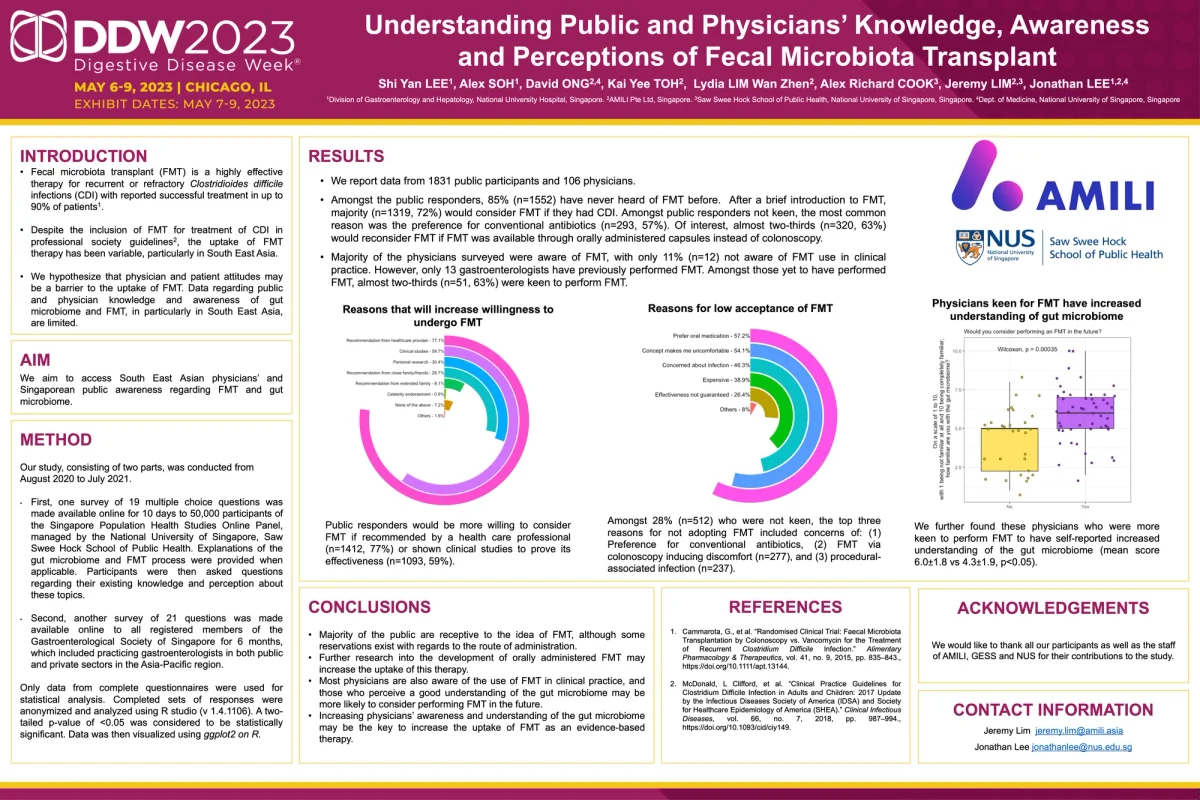
We report data from 1831 public participants and 106 physicians. Amongst the public responders, 85% (n=1552) have never heard of FMT before. After a brief introduction to FMT, majority (n=1319, 72%) would consider FMT if they had CDI. Amongst public responders not keen, the most common reason was the preference for conventional antibiotics (n=293, 57%). Of interest, almost two-thirds (n=320, 63%) would reconsider FMT if FMT was available through orally administered capsules instead of colonoscopy. Majority of the physicians surveyed were aware of FMT, with only 11% (n=12) not aware of FMT use in clinical practice. However, only 13 gastroenterologists have previously performed FMT. Amongst those yet to have performed FMT, almost two-thirds (n=51, 63%) were keen to perform FMT.
- Public responders would be more willing to consider FMT if recommended by a health care professional (n=1412, 77%) or shown clinical studies to prove its effectiveness (n=1093, 59%).
- Amongst 28% (n=512) who were not keen, the top three reasons for not adopting FMT included concerns of: (1) Preference for conventional antibiotics, (2) FMT via colonoscopy inducing discomfort (n=277), and (3) procedural-associated infection (n=237).
- We further found these physicians who were more keen to perform FMT to have self-reported increased understanding of the gut microbiome (mean score 6.0±1.8 vs 4.3±1.9, p<0.05).
CONCLUSIONS
Majority of the public are receptive to the idea of FMT, although some
reservations exist with regards to the route of administration. Further research into the development of orally administered FMT may increase the uptake of this therapy. Most physicians are also aware of the use of FMT in clinical practice, and those who perceive a good understanding of the gut microbiome may be more likely to consider performing FMT in the future. Increasing physicians’ awareness and understanding of the gut microbiome may be the key to increase the uptake of FMT as an evidence-based therapy.