Lactobacillus plantarum Benefits: How It Works in Your Gut
The benefits of Lactobacillus plantarum start with surviving stomach acid and sticking to the gut lining. Strain 299v is linked to less IBS bloating.
By Angad Mahajan and Yuzu Tay
Medically reviewed by Nicole Wee
Updated 18 Nov 2026 · 10 min read


Key takeaways
- L. plantarum is a lactic acid bacterium found in fermented vegetables such as kimchi and sauerkraut, and in the human gut.
- It tolerates stomach acid and bile well, so it often reaches the intestine alive.
- In lab studies it attaches to the gut lining, makes acids that hold back some harmful bacteria and increases mucin gene activity, though these effects have not all been confirmed in people.
- The clearest human evidence is for one strain, L. plantarum 299v, which was associated with less abdominal pain and bloating in adults with irritable bowel syndrome (IBS).
- Baking kills it, so look for unpasteurised fermented vegetables labelled as containing live cultures rather than sourdough bread.
- If you try a supplement for bloating, the studies suggest daily use for at least four weeks, with a strain and dose that has been tested in people.
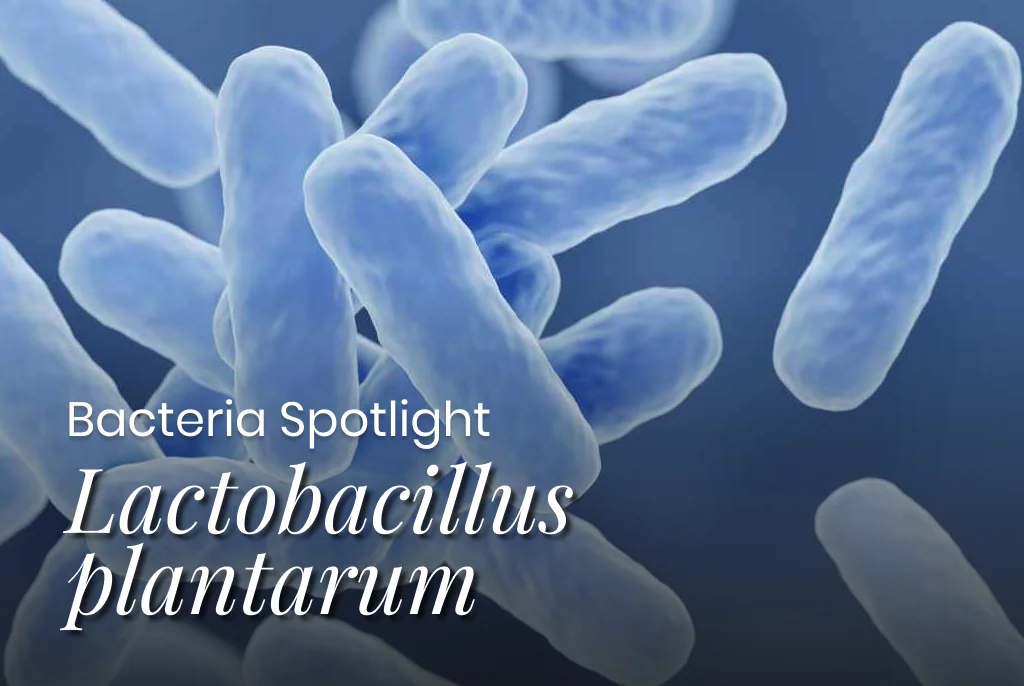
Lactiplantibacillus plantarum is a lactic acid bacterium found extensively across plant material, fermented foods, and mammalian gastrointestinal tracts. [1]
It has one of the largest genomes of any lactic acid bacterium, which is why it can adapt to so many different places and foods. [1] Its genetic architecture encodes diverse enzymes capable of hydrolysing complex plant carbohydrates, phenolic compounds, and plant storage polymers. Microbiologists classify L. plantarum as a "nomadic" organism: rather than being restricted to a single host or environment, it thrives across a wide spectrum of ecological niches, ranging from plant surfaces and sourdough fermentations to human mucosal surfaces such as the mouth and the intestinal lining. [1, 4]
How Does L. plantarum Survive the Trip Through Your Gut?
Before a probiotic can do anything for you, it has to survive the journey through your stomach and small intestine, where acid and bile are harsh on most bacteria, and arrive in your colon alive. L. plantarum has a natural tolerance to physiological barriers, particularly gastric acid secretions and bile salts. [1]
Surviving Stomach Acid and Bile
Hydrochloric acid keeps the stomach at a pH of about 1.5 to 2.0, which destroys most of the microorganisms swallowed with food. [5] In vitro stress-tolerance assessments show that L. plantarum maintains high cellular viability even after exposure to acidic environments because it buffers acid inside the cell and uses pumps in its membrane to push excess acid back out. [1]
In the small intestine, bacteria meet bile. Bile acids work like a natural detergent and can break down the outer membrane of a bacterial cell. L. plantarum strains produce bile salt hydrolase (BSH), an enzyme that deconjugates bile acids and may protect bacterial cells from bile-induced damage. [1]
For you, this hardiness means that a good share of the L. plantarum you swallow, whether in a fermented food or a capsule, can reach your intestine alive, which is where it acts. It is also one reason researchers regard it as a strong probiotic candidate. [1]
Sticking to Your Gut Lining
L. plantarum can attach to the lining of your gut. Its cell wall contains an array of specialised surface molecules, including mucus-binding proteins (MUBs) and mannose-specific adhesins. [1]
In a study of healthy volunteers who ate a fermented oatmeal soup containing 19 Lactobacillus strains, including L. plantarum 299v, for 10 days, lactobacilli levels on the lining of the small intestine were still high 11 days after they stopped. [4]
In practical terms, L. plantarum can stay on your gut lining for a while after you stop, but the human trials described below gave it every day. So regular intake is what has been tested, rather than an occasional serving. [2, 3, 4]
The sequence of intestinal transit and adherence follows five stages:
- Oral Ingestion: Consumed through fermented plant foods or targeted dietary supplements.
- Gastric Acid Transit: Resists low gastric pH using active membrane-bound proton export and intracellular buffering. [1]
- Bile Detoxification: Deconjugates bile acids in the small intestine via bile salt hydrolase activity. [1]
- Enterocyte Adhesion: Adheres to the intestinal mucus layer via surface adhesins such as mannose-specific adhesin. [1, 4]
- Competing with other microbes: May compete with less desirable gut bacteria for adhesion sites and nutrients, a mechanism known as competitive exclusion. [1]
What Does It Do Once It Reaches Your Gut?
Competing With Harmful Bacteria
L. plantarum competes with harmful bacteria for space on your gut lining. In laboratory studies using cultured intestinal cells, L. plantarum strains were able to inhibit and even displace pathogens such as E. coli and Listeria monocytogenes from the cell surface. In addition to physical space competition, L. plantarumsynthesises and secretes bacteriocins, ribosomally produced antimicrobial peptides that form pores in the cell membranes of competing bacterial strains, inhibiting their proliferation. [1]
Making the Gut More Acidic
During carbohydrate metabolism, L. plantarum uses homolactic and heterolactic fermentation pathways to convert hexose and pentose sugars into organic acids, predominantly lactic acid and acetic acid. [6] These acids make the space around it more acidic. Because many harmful gut bacteria grow best in less acidic conditions, this local drop in pH may make it harder for them to settle. [1]
Supporting the Mucus That Protects Your Gut
L. plantarum may also help the mucus layer that protects your gut. In a lab study using human intestinal cells, L. plantarum 299v increased the activity of two mucin genes, MUC2 and MUC3. Mucins are the proteins that make up the mucus lining the gut, and MUC2 is the main one that forms its protective gel. In the same cell-culture experiments, this increase in mucin expression was associated with reduced attachment of enteropathogenic Escherichia coli to the intestinal cells. [7]
Helping Keep the Gut Lining Sealed
The cells lining your gut are held together by tight junctions, which stop bacteria and their toxins from leaking into the rest of your body. L. plantarum may help support the barrier integrity by regulating the assembly and distribution of tight junction proteins, including zonula occludens-1 (ZO-1) and occludin. [1] Animal studies have also reported that L. plantarum can counteract increases in gut permeability and improve barrier integrity. [1]
Most of the effects in this section were seen in cells or animals. They describe what L. plantarum can do under controlled conditions rather than what it will do in your own gut, and they are the reason researchers went on to test it in people, as the next section describes.
What Are the Benefits of Lactobacillus plantarum in Human Trials?
The clearest human evidence comes from one strain, L. plantarum 299v, tested in adults with irritable bowel syndrome (IBS). In a four-week, double-blind, randomised, placebo-controlled clinical trial involving 214 adults in India diagnosed with IBS using the Rome III criteria, people took 10 billion colony-forming units (CFU) of L. plantarum 299v (DSM 9843) a day. Compared with those taking a placebo, people taking L. plantarum 299v experienced a significantly faster and more pronounced reduction in the frequency and severity of abdominal pain, as well as less bloating. [2]
A 12-week observational study across 25 medical centres in Germany, which had no placebo group, reported a similar pattern. [3] Evaluating 221 IBS patients taking L. plantarum 299v, the investigators documented significant progressive improvements in abdominal bloating, pain intensity, and feelings of incomplete evacuation, with clinical efficacy improving over the duration of the intervention. [3]
In the Indian trial, 78% of people taking L. plantarum 299v rated its effect on their symptoms as excellent or good after four weeks, compared with 8% of those on placebo. [2] The German study found that results kept building over 12 weeks and that people tolerated the strain well over that time. [3] The people in both studies had IBS, so results may differ for occasional bloating. If you are trying it for tummy discomfort, these studies suggest giving it at least four weeks of daily use before deciding whether it helps.
While these trials show that targeted L. plantarum uses are associated with reduced symptoms in functional bowel disorders, probiotic therapies serve as adjunctive nutritional support rather than standalone treatments. [2, 3]
Why Does What You Eat Matter for L. plantarum?
L. plantarum needs sugars from your food to survive, grow and make its acids. Different foods supply different sugars for it to ferment. [8]
How It Feeds Other Gut Bacteria
When L. plantarum ferments sugars, it releases lactate and acetate. [8] Other gut bacteria can use these acids to make butyrate, a short-chain fatty acid that is the main fuel for the cells lining your colon, in a process researchers call cross-feeding. A lab study showed this with Faecalibacterium prausnitzii, which used acetate made by a Bifidobacterium strain to produce more butyrate. [9] That study did not include L. plantarum, but it shows how the acids one species makes can feed another.
Which Foods Contain Lactobacillus plantarum?
L. plantarum is one of the bacteria that commonly sour fermented vegetables. [1] Live bacteria are most likely in unpasteurised versions labelled as containing live cultures.
- Kimchi: A traditional fermented vegetable dish made from napa cabbage and Korean radish.
- Sauerkraut: Fermented white cabbage prepared with salt.
- Fermented Mustard Greens: Preserved leafy vegetables common in East and Southeast Asian cuisine.
- Fermented Soy Products: Preserved soybean preparations, including tempeh.
- Sourdough starter: L. plantarum is common in sourdough starters, but baking kills the bacteria, so the finished bread does not contain live L. plantarum.
Does Eating Kimchi Give You the Same Benefits as the Studies?
Not necessarily, although fermented vegetables are still a good way to eat live bacteria. In kimchi, L. plantarumtends to take over in the later, sourer stages of fermentation, so a well-aged kimchi is more likely to contain plenty of it than a freshly made one. [10]
What a jar cannot tell you is which strain it contains or how much of it is alive. The human trials in this article tested one strain, 299v, at a measured daily dose, so their results do not carry over to a fermented food. [2, 3] Fermented foods are not always alive either. Some are pasteurised after fermentation, which kills the bacteria, and the scientific consensus is that these should be described as foods made by fermentation rather than foods with live cultures. [11]
This does not make fermented vegetables less worth eating. A chilled, unpasteurised kimchi or sauerkraut eaten regularly is an easy way to add live lactic acid bacteria to your diet, while a supplement is the way to get a specific, tested strain at a known dose. [11]
Does Taking Lactobacillus plantarum as a Supplement Work?
For one strain, the evidence is encouraging but limited. L. plantarum 299v taken daily has been associated with less abdominal pain and bloating in adults with IBS. [2, 3] Whether a supplement can do this depends on what it has to get through on the way.
Surviving the stomach. L. plantarum tolerates acid and bile better than many bacteria, so a good share can reach the intestine alive. [1]
Reaching useful numbers. The IBS studies gave 10 billion colony-forming units (CFU) of L. plantarum 299v a day. [2, 3] Their results apply to that strain at that dose, so a product with a different strain or a lower count has not been tested in the same way.
Staying present. In a study of healthy volunteers, lactobacilli including L. plantarum 299v were still found on the gut lining 11 days after people stopped eating them. [4] In the IBS studies, symptoms were measured while people were taking the strain every day. [2, 3]
Because results depend on the strain and the dose, a few details on a probiotic label tell you most of what you need to know. [12]
The full name. Look for the genus and species and, where the brand gives one, a strain code such as 299v. A strain code lets you look up whether that exact strain has been studied.
The count at expiry. Check whether the CFU count is guaranteed until the end of shelf life rather than only at manufacture, because live bacteria die off during storage.
How long and how often. Plan to take it daily for as long as the studies did, which for the IBS trials in this article was four to 12 weeks. [2, 3]
AMILI Digestion Daily Synbiotics pairs L. plantarum and L. rhamnosus at 7 billion CFU each with L. reuteri, prebiotic fibres and a postbiotic, in targeted-release capsules. It is formulated using AMILI's gut microbiome data from Asia and helps relieve bloating through a balanced, diverse gut community. Its L. plantarum strain is not 299v, and the formula has not been tested in the IBS studies described above, so their results do not carry over to it directly. L. plantarum is also in AMILI Complete, Immunity and Mind & Brain Daily Synbiotics. To see which one suits you, find your match with GutMatch in 2 minutes.
Frequently asked questions
References
- 1.Fidanza, M., Panigrahi, P., & Kollmann, T. R. (2021). Lactiplantibacillus plantarum–nomad and ideal probiotic. Frontiers in Microbiology, 12, Article 712236. https://doi.org/10.3389/fmicb.2021.712236
- 2.Ducrotté, P., Sawant, P., & Jayanthi, V. (2012). Clinical trial: Lactobacillus plantarum 299v (DSM 9843) improves symptoms of irritable bowel syndrome. World Journal of Gastroenterology, 18(30), 4012–4018. https://doi.org/10.3748/wjg.v18.i30.4012
- 3.Krammer, H., Storr, M., Madisch, A., & Riffel, J. (2021). Reizdarmbehandlung mit Lactobacillus plantarum 299v: Längere Einnahme verstärkt Behandlungserfolg – Ergebnisse einer nichtinterventionellen Studie [Treatment of IBS with Lactobacillus plantarum 299v: Therapeutic success increases with length of treatment – real-life data of a non-interventional study in Germany]. Zeitschrift für Gastroenterologie, 59(2), 125–134. https://doi.org/10.1055/a-1340-0204
- 4.Johansson, M. L., Molin, G., Jeppsson, B., Nobaek, S., Ahrné, S., & Bengmark, S. (1993). Administration of different Lactobacillus strains in fermented oatmeal soup: In vivo colonization of human intestinal mucosa and effect on the indigenous flora. Applied and Environmental Microbiology, 59(1), 15–20. https://doi.org/10.1128/aem.59.1.15-20.1993
- 5.Ogobuiro, I., Gonzales, J., Shumway, K. R., & Tuma, F. (2023). Physiology, gastrointestinal. In StatPearls. StatPearls Publishing. https://www.ncbi.nlm.nih.gov/books/NBK537103/
- 6.Zheng, J., Wittouck, S., Salvetti, E., Franz, C. M. A. P., Harris, H. M. B., Mattarelli, P., O’Toole, P. W., Pot, B., Vandamme, P., Walter, J., Watanabe, K., Wuyts, S., Felis, G. E., Gänzle, M. G., & Lebeer, S. (2020). A taxonomic note on the genus Lactobacillus: Description of 23 novel genera, emended description of the genus Lactobacillus Beijerinck 1901, and union of Lactobacillaceae and Leuconostocaceae. International Journal of Systematic and Evolutionary Microbiology, 70(4), 2782–2858. https://doi.org/10.1099/ijsem.0.004107
- 7.Mack, D. R., Michail, S., Wei, S., McDougall, L., & Hollingsworth, M. A. (1999). Probiotics inhibit enteropathogenic E. coli adherence in vitro by inducing intestinal mucin gene expression. American Journal of Physiology-Gastrointestinal and Liver Physiology, 276(4), G941–G950. https://doi.org/10.1152/ajpgi.1999.276.4.G941
- 8.Cui, Y., Wang, M., Zheng, Y., Miao, K., & Qu, X. (2021). The carbohydrate metabolism of Lactiplantibacillus plantarum. International Journal of Molecular Sciences, 22(24), Article 13452. https://doi.org/10.3390/ijms222413452
- 9.Rios-Covian, D., Gueimonde, M., Duncan, S. H., Flint, H. J., & de los Reyes-Gavilan, C. G. (2015). Enhanced butyrate formation by cross-feeding between Faecalibacterium prausnitzii and Bifidobacterium adolescentis. FEMS Microbiology Letters, 362(21), Article fnv176. https://doi.org/10.1093/femsle/fnv176
- 10.Lee, M.-E., Jang, J.-Y., Lee, J.-H., Park, H.-W., Choi, H.-J., & Kim, T.-W. (2015). Starter cultures for kimchi fermentation. Journal of Microbiology and Biotechnology, 25(5), 559–568. https://doi.org/10.4014/jmb.1501.01019
- 11.Marco, M. L., Sanders, M. E., Gänzle, M., Arrieta, M. C., Cotter, P. D., De Vuyst, L., Hill, C., Holzapfel, W., Lebeer, S., Merenstein, D., Reid, G., Wolfe, B. E., & Hutkins, R. (2021). The International Scientific Association for Probiotics and Prebiotics (ISAPP) consensus statement on fermented foods. Nature Reviews Gastroenterology & Hepatology, 18(3), 196–208. https://doi.org/10.1038/s41575-020-00390-5
- 12.Binda, S., Hill, C., Johansen, E., Obis, D., Pot, B., Sanders, M. E., Tremblay, A., & Ouwehand, A. C. (2020). Criteria to qualify microorganisms as “probiotic” in foods and dietary supplements. Frontiers in Microbiology, 11, Article 1662. https://doi.org/10.3389/fmicb.2020.01662
- 13.Xu, Z., Zhang, S., & Wang, T. (2024). Perspective chapter: Lactose metabolism by Lactiplantibacillus plantarum. In Y. Karamanos (Ed.), Metabolism annual volume 2024. IntechOpen. https://doi.org/10.5772/intechopen.109134
This article is for general information and does not replace advice from your doctor. Speak to a healthcare professional before making changes to your treatment.
Written
Written by
Angad Mahajan

Written by
Yuzu Tay
Yuzu Tay is a science communicator trained in biomedical engineering. Her focus is on translating and sharing real science to help people make better decisions about their health.
View profileReviewed by
Nicole Wee